
Choosing a shipping container may seem straightforward. If you have a large shipment, you might assume that a 40-foot container is the obvious choice. If the cargo is smaller, a 20-foot container should be enough.
In practice, it is not quite that simple.
The right container depends on more than the amount of cargo you have. Weight, cargo dimensions, packaging, pallet configuration, loading requirements, and available space can all affect which container makes the most sense for your shipment.
Choosing the wrong size can leave you paying for unused space, hitting the container's weight limit before it is full, or dealing with loading problems that could have been avoided before the booking was made.
This guide explains the most common shipping container sizes, how much each one can typically hold, and what to consider before choosing one for your next shipment.
Key Takeaways
- The most common shipping containers are 20-foot, 40-foot, and 40-foot high cube containers.
- Each container has different internal dimensions, cubic capacity, door dimensions, and payload limits.
- The best container depends on your cargo's total volume, weight, dimensions, and loading requirements.
- A 20-foot container is generally better suited to dense, heavy cargo, while 40-foot and high cube containers are often a better fit for lighter but bulkier shipments.
- Choosing a container based only on available space can lead to unnecessary costs or loading problems.
The important point is that container selection is not simply a matter of choosing the biggest box available. You want enough room for your cargo without paying for capacity you cannot use.
For businesses importing machinery, consumer products, furniture, palletized goods, or other commercial cargo, understanding the differences between common container types can make the booking process much easier.
The Basics of Shipping Containers
Shipping containers are standardized so they can move efficiently between ships, ports, rail networks, and trucks around the world.
That standardization is what makes containerized shipping work. A container loaded at an overseas factory can generally move through several different parts of the supply chain without the cargo itself being unloaded.
However, standardization does not mean every container has the same capacity.
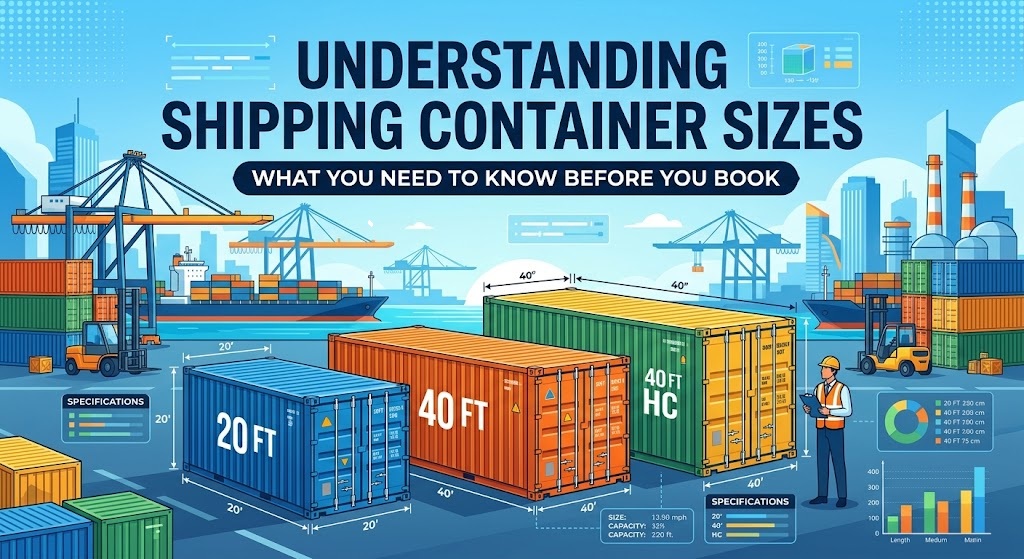
A 20-foot container, a standard 40-foot container, and a 40-foot high cube may look similar from the outside, but their internal dimensions and usable volume are different.
Before selecting a container, look at three basic questions:
- How much space does the cargo require?
- How much does the cargo weigh?
- How will the cargo be packed and loaded?
These details give you a much better starting point than simply estimating the shipment as "large" or "small."
Standard Container Dimensions: What to Expect
The following table provides a general comparison of the most commonly used dry containers.
| Container Type | External Dimensions (L x W x H) | Internal Dimensions (L x W x H) | Door Opening (W x H) | Internal Volume (approx.) | Max Payload |
|---|---|---|---|---|---|
| 20 ft Standard | 20′ x 8′ x 8’6″ | 19’4″ x 7’8″ x 7’10” | 7’8″ x 7’6″ | ~33.2 m³ | ~28,000 kg / 61,700 lbs |
| 40 ft Standard | 40′ x 8′ x 8’6″ | 39’5″ x 7’8″ x 7’10” | 7’8″ x 7’6″ | ~67.7 m³ | ~28,800 kg / 63,500 lbs |
| 40 ft High Cube | 40′ x 8′ x 9’6″ | 39’5″ x 7’7″ x 8’10” | 7’8″ x 8’6″ | ~76.4 m³ | ~28,800 kg / 63,500 lbs |
There are a few practical differences worth keeping in mind.
20-Foot Shipping Container
A 20-foot container has less internal volume than a 40-foot container, but its capacity is often a better match for dense or heavy cargo.
40-Foot Shipping Container
A 40-foot container provides roughly twice the internal volume of a 20-foot container. That does not mean it can carry twice the weight, however.
This distinction matters when you are shipping dense products. You may run out of allowable payload before you run out of physical space.
40-Foot High Cube Container
A high cube container has the same basic length and width as a standard 40-foot container but provides an additional foot of height.
That extra vertical space can be useful when you are shipping lightweight goods that take up a lot of cubic volume or cargo that needs additional loading height.
Choosing the Right Container for Your Cargo
There is no single container size that works best for every shipment.
The better approach is to start with your cargo and work backward.
Ask yourself how much the shipment weighs, how much space it occupies, whether it is palletized, and whether any individual pieces have unusual dimensions.
20 Foot Shipping Container
A 20-foot shipping container is often a practical choice for dense and relatively heavy cargo, including:
- Machinery
- Metals
- Paper products
- Bagged agricultural goods
The main advantage is that you can use the available payload without needing a large amount of cubic space.
For example, if you are shipping a relatively compact load of heavy machinery, choosing a 40-foot container simply because it provides more space may not give you any real advantage. The cargo could reach the container's weight limit long before the available volume is used.
For dense cargo, a 20-foot container can therefore be a more efficient option.
40 Foot Shipping Container
A 40-foot shipping container is widely used for lighter or moderately heavy cargo that takes up more space.
Typical examples include:
- Furniture
- Clothing
- Electronics
- Home goods
The main benefit is straightforward: more internal space.
If your shipment is driven by volume rather than weight, the additional capacity of a 40-foot container can make loading much more efficient.
There is one important limitation to remember. A 40-foot container does not have twice the weight capacity of a 20-foot container. If your cargo is particularly dense, you may reach the allowable weight before filling the available space.
High Cube Container
A 40-foot high cube container is useful when vertical space is important.
It can be a good fit for:
- High-volume cargo such as raw cotton or mattresses
- Goods loaded on taller pallets
- Lightweight products that occupy significant cubic space
The additional height gives you more usable volume than a standard 40-foot container.
However, the extra space does not come with a dramatically higher payload allowance. If your cargo is heavy rather than bulky, the additional height may not provide much practical benefit.
Visualizing Container Space: A Practical Comparison
Container dimensions can be difficult to picture when you are looking at numbers on a booking sheet.
A simple way to think about capacity is in terms of pallets or household contents.
- 20 ft Standard: roughly comparable to the contents of a 1–2 bedroom apartment or around 10 standard pallets.
- 40 ft Standard: can accommodate approximately the contents of a 3–4 bedroom home or up to 20 standard pallets.
- 40 ft High Cube: provides a similar pallet footprint to a standard 40-foot container, but the additional height creates more room for tall or stackable cargo.
These figures are only practical estimates. Actual capacity depends on pallet dimensions, packaging, cargo shape, stacking rules, and how efficiently the container is loaded.
For that reason, pallet count can be a useful starting point, but it should not replace an actual volume and weight calculation.
If you are consolidating products from several suppliers, this becomes even more important. Your total cargo may look manageable until you account for pallet sizes, packaging, and the space that cannot be efficiently used.
Tips to Avoid Overpaying for Unused Space
One of the easiest mistakes to make is choosing a larger container "just in case."
More space sounds safer, but unused container capacity still costs money.
Before booking, consider the following.
1. Measure Accurately
Start with the basics: total cargo volume and total cargo weight.
If possible, collect the dimensions and weight of each carton, pallet, or individual piece. Your freight forwarder can then help calculate the total cubic meters (CBM) and determine which container is the closest fit.
The more accurate your measurements are, the less likely you are to book a container that is unnecessarily large.
2. Consolidate Smartly
If your shipment does not require a full container, LCL (less-than-container load) may be worth considering.
LCL allows your cargo to share container space with other shipments. In some cases, better packaging or consolidation can reduce the amount of space your cargo requires.
However, LCL is not automatically cheaper in every situation. Handling charges, origin and destination fees, and the total shipment volume should all be considered before making the decision.
3. Consider the Type of Cargo
Heavy and compact cargo generally favors a 20-foot container.
Bulky but relatively lightweight cargo is usually better suited to a 40-foot or high cube container.
The key is to balance weight against volume, rather than looking at volume alone.
4. Don't Overload
Every container has a maximum payload limit.
Exceeding the applicable weight limit can create additional costs and operational problems, including delays, rejected cargo, or the need to repack and adjust the shipment.
Your cargo should therefore be checked against both the container's available volume and its allowable payload before the booking is finalized.
Work With a Freight Forwarder to Maximize Efficiency
For straightforward shipments, selecting between a 20-foot and 40-foot container may seem easy.
In real-world international shipping, however, container availability, carrier requirements, port conditions, loading limitations, and seasonal demand can all affect the decision.
An experienced freight forwarder can help you:
- Compare carrier options and current container availability
- Identify potential space constraints during busy shipping periods
- Coordinate documentation, customs, and port requirements
- Determine which container size best matches your cargo and budget
This can be particularly helpful if you are importing for the first time or only arrange international shipments occasionally.
The goal is not simply to put your cargo into a container. It is to select an option that works from the factory or warehouse through the port and final delivery without creating avoidable costs along the way.
The Right Container, The Right Strategy
Choosing the right container is ultimately about matching your cargo to the capacity that makes the most sense.
A 20-foot container can be efficient for dense, heavy products. A 40-foot container gives you substantially more room for larger-volume shipments. A high cube adds even more cubic capacity when height is the limiting factor.
But bigger is not automatically better.
Before you book, take the time to confirm your cargo dimensions, total weight, pallet configuration, and loading requirements. Then compare those figures with the available container options.
A few minutes spent checking the numbers before booking can help you avoid paying for unused space, dealing with weight restrictions, or discovering that your cargo does not fit as expected.
The right container is the one that gives your shipment enough usable capacity without creating unnecessary cost or operational headaches.
Need Help Selecting the Best Container for Your Next Shipment?
If you are not sure whether your cargo requires a 20-foot, 40-foot, or high cube container, start with your actual shipment details rather than choosing based on a general estimate.
Your freight partner can review the cargo dimensions, weight, packaging, and loading requirements and help determine the most practical option.
This is especially useful when you are shipping a mixed load, working with multiple suppliers, or dealing with cargo that is unusually heavy, tall, or bulky.
Interested in shipping your freight internationally? Get a quote before booking so you can compare the available container options and understand the expected shipping cost.