
Landed cost is what a product really costs you by the time it arrives at its final destination and is ready for the next step in your supply chain. That means you’re looking at more than the price you paid your supplier. Freight, customs duties, taxes, insurance, handling, and other expenses can all add to the final number.
This matters because the price on a supplier’s invoice rarely tells the whole story. A product may look inexpensive when you first place the order, but once you add the costs of getting that inventory across borders and into your warehouse, the actual cost can be much higher.
In simple terms:
Don’t stop at the product price. Landed cost gives you a clearer picture of what each product actually costs once all of the expenses required to get it where it needs to go are included
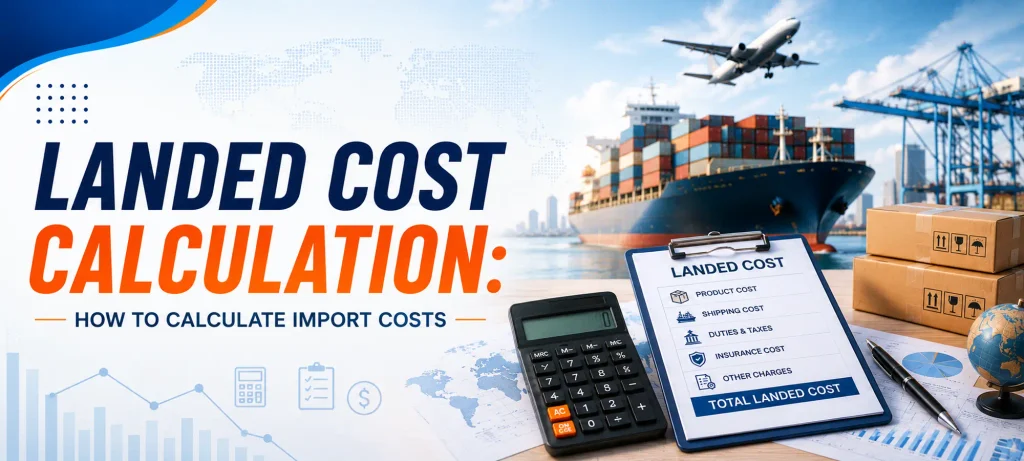
What Is Landed Cost?
Landed cost, sometimes called total landed cost, is the total amount a business spends to purchase, transport, clear, and receive inventory at its intended destination.
Depending on the shipment, that can include:
- Product purchase price
- Freight and transportation costs
- Customs duties and tariffs
- Taxes and import fees
- Insurance
- Handling and port charges
- Payment and currency conversion fees
- Other direct costs required to receive the goods
The important part is that landed cost gives you a more complete picture than the supplier’s quoted price alone.
For example, imagine you purchase a product from an overseas supplier for $20 per unit. Once freight, customs duties, insurance, and handling are added, your actual landed cost could be $28 per unit.
That $8 difference may not seem significant on one product. But when you’re ordering thousands of units, it can have a meaningful impact on your margins.
How to Calculate Landed Cost
At its simplest, the landed cost formula looks like this:
Landed Cost = Product Cost + Shipping + Customs + Insurance + Handling + Other Applicable Costs
That’s the basic calculation, but real-world shipments can be more complicated. Depending on your operation, you may also need to account for payment processing, currency conversion, compliance costs, or other expenses associated with getting inventory into your facility.
Simple Example
Let’s say a company imports 500 units of a product.
- Product cost: $10 per unit
- International shipping: $1,000
- Import duty: 2%
- Insurance: $200
- Payment and handling fees: $1,000
First, calculate the shipping cost per unit:
$1,000 ÷ 500 = $2
Then calculate the insurance cost per unit:
$200 ÷ 500 = $0.40
The import duty is:
$10 × 2% = $0.20
Now add everything together:
$10 + $2 + $0.20 + $0.40 + $2 = $14.60
So while the supplier’s product price is only $10 per unit, the actual landed cost is $14.60 per unit.
That $14.60 is the number you want to pay attention to when you’re looking at product profitability, pricing, and whether a particular sourcing strategy makes financial sense.
What are the components of total landed costs?
There isn’t one universal landed cost calculation that works for every shipment. The expenses can change based on the product, where it comes from, where it’s going, how it moves, and the terms you agreed to with your supplier.
Here are the costs you’ll typically want to consider.
Product Cost
This is the price you pay your supplier or manufacturer for the goods.
It’s usually where the calculation starts, but it’s important not to treat it as the final cost. The price you negotiate with the factory only tells you what the product itself costs. It doesn’t tell you what it will cost to get that product into your warehouse and ready for sale.
Transportation Costs
Getting inventory from a supplier to its final destination can involve several different transportation steps.
These may include:
- Pickup from the supplier
- Inland transportation
- Ocean or air freight
- Destination transportation
- Final delivery
If your shipment moves through multiple transportation stages, each applicable cost needs to be included.
This is one reason a freight quote that looks inexpensive at first doesn’t always translate into the lowest landed cost.
Customs Duties and Tariffs
Customs duties and tariffs are based on the rules of the country where the goods are being imported.
The amount you pay can depend on factors such as:
- Product classification
- Country of origin
- Destination country
- Trade agreements
- Applicable tariff programs
Getting these costs wrong can make a noticeable difference in your final landed cost. A product that looks profitable on paper can become much less attractive once the correct duties and tariffs are included.
Taxes and Government Fees
Depending on where you’re importing, your shipment may be subject to VAT, sales tax, import taxes, or other government charges.
Not every business treats these costs in exactly the same way for accounting purposes. But if a particular tax or government fee represents a real expense for your shipment, it should be considered when you calculate landed cost.
Insurance
Cargo insurance helps protect your shipment against risks such as damage, theft, or loss while the goods are being transported.
It may be especially important when you’re moving high-value, fragile, or otherwise difficult-to-replace products.
If insurance is part of what you pay to get the inventory to its destination, include it in your landed cost calculation.
Handling and Port Charges
This is another area where costs can quietly add up.
Depending on your shipment, you may run into expenses such as:
- Customs brokerage
- Port handling
- Terminal charges
- Warehousing
- Documentation
- Demurrage
- Other destination charges
You won’t necessarily pay all of these fees on every shipment. The problem is that leaving them out when they do apply can make your landed cost look better than it really is.
Currency and Payment Costs
International sourcing can also bring financial costs that are easy to overlook.
Depending on how you pay suppliers and service providers, you may have:
- Currency conversion costs
- Bank charges
- Payment processing fees
- Exchange-rate differences
These costs may be small on individual transactions, but they can become much more noticeable when you’re buying inventory from multiple countries or moving significant amounts of money across currencies.
Why Landed Cost Is Important
Landed cost gives you a much better idea of what your inventory actually costs once it reaches its destination.
Without it, it’s easy to compare suppliers based on the number on a quote while overlooking the freight, duties, taxes, and other expenses that come afterward.
That can lead to pricing decisions and profit projections that look good on paper but don’t hold up once the bills start coming in.
Better Product Pricing
Knowing your true landed cost makes it easier to set prices based on what you’re actually spending.
If you price a product using only its purchase cost and ignore freight, duties, taxes, and other expenses, your actual margin may be considerably smaller than expected.
Landed cost gives you a better starting point for deciding what you need to charge.
More Accurate Profit Margins
Your product margin is only as useful as the costs behind it.
For example, imagine two suppliers offer similar products at different prices. Supplier A may have the lower factory price, while Supplier B charges more per unit.
At first glance, Supplier A looks like the obvious choice.
But once you add freight, customs duties, insurance, and handling, Supplier B could actually give you the lower landed cost.
That’s why looking at the complete cost is often more useful than comparing supplier quotes line by line.
Better Supplier Selection
The cheapest supplier isn’t always the cheapest source.
When you compare landed costs instead of just purchase prices, you can evaluate suppliers based on the full cost of getting inventory into your operation.
This becomes particularly useful when you’re comparing suppliers in different countries, where freight rates, duties, taxes, and other import costs can vary significantly.
The number on the supplier’s quote is only one part of the decision.
More Accurate Budgeting
Landed cost can also make inventory planning and budgeting much easier.
Once you have a realistic estimate of what it will cost to purchase and receive inventory, you can build a more accurate budget and reduce the chance of being surprised by import or logistics expenses later.
That can help with purchasing decisions, inventory planning, cash flow, and financial forecasting.
Improved Supply Chain Decisions
Tracking landed costs over time can show you where your money is actually going.
Maybe one supplier consistently has lower freight costs. Maybe another sourcing location has better duty rates. Maybe a different transportation method makes more sense for certain products.
Once those costs are visible, you can compare suppliers, transportation methods, sourcing locations, and shipping strategies based on actual numbers instead of assumptions.
Factors that affect total landed cost
Landed cost isn’t a fixed number. It can change from shipment to shipment depending on several factors.
Shipping Method
Air freight, ocean freight, road transportation, rail, and multimodal shipping all come with different cost structures.
The cheapest option depends on what you’re shipping, how much you’re moving, where it’s going, and how quickly you need it.
For some products, ocean freight may make the most sense. For smaller or time-sensitive shipments, air freight may justify the higher transportation cost.
Shipping Distance
The farther your inventory has to travel, the more transportation and handling costs can enter the calculation.
You also need to consider how many times the shipment changes hands or transportation modes along the way.
A longer route with more handling points can create a very different landed cost from a shorter, more direct route.
Customs Duties and Tariffs
Duty rates vary depending on the product and destination.
That means a change in tariff policy can increase your landed cost even if the supplier hasn’t changed the price of the product.
For importers, this is one reason it’s important to review tariff and customs costs regularly rather than treating them as a permanent fixed expense.
Incoterms
The Incoterm you agree to with your supplier determines who is responsible for different parts of the shipping, customs, insurance, and delivery process.
For example, under EXW, the buyer generally takes on more transportation responsibilities. Under DDP, the seller takes on considerably more responsibility for delivery and import-related costs.
The important thing is to know exactly what your quoted price includes before using it in a landed cost calculation.
Always confirm the Incoterm before calculating landed cost.
Shipment Volume
Shipment volume can change your cost per unit because many transportation and handling expenses are spread across the number of products being shipped.
A larger shipment may lower the transportation cost per unit.
At the same time, larger inventory volumes can increase warehousing, storage, handling, and inventory carrying costs.
So bigger isn’t automatically better. You need to look at the full picture.
Currency Exchange Rates
If your supplier and your business use different currencies, exchange-rate movements can affect your final cost.
A relatively small change in an exchange rate may not matter much for one small order. On a large international purchase, however, the difference can become significant.
Insurance and Risk
Insurance costs can vary based on the value of your cargo, the product itself, the transportation method, and the route.
You should also think beyond the insurance premium.
Damage, loss, delays, compliance problems, and supply chain disruptions can all create additional costs. Understanding those risks gives you a more realistic view of what it takes to source and move your inventory.
Port, Storage, and Handling Charges
Port fees, terminal charges, storage, demurrage, and other handling expenses can increase landed cost, particularly when cargo is delayed or requires additional services.
These costs are easy to miss when you’re calculating your total cost from only the supplier invoice and the basic freight quote.
That’s why a complete landed cost calculation needs to look at the entire journey, not just the first and most obvious expenses.
Final Conclusion
Landed cost gives you a more realistic picture of what your inventory actually costs once it reaches its destination.
Instead of looking only at the supplier’s unit price, take the full cost into account:
- 📦 Product cost
- 🚢 Shipping and transportation
- 🧾 Customs duties and tariffs
- 💰 Taxes and fees
- 🛡️ Insurance
- 📍 Handling and destination charges
- 💱 Currency and payment costs
The goal isn’t simply to create another spreadsheet.
A good landed cost calculation helps you understand whether a product is actually profitable, whether a supplier is really offering a good deal, and where you may be able to reduce costs across your supply chain.
When you know what your inventory truly costs, you can make better sourcing decisions, set more realistic prices, protect your margins, and avoid unpleasant surprises when the freight and import bills arrive.
Frequently Asked Questions
What is landed cost?
Landed cost is the total cost of purchasing and getting a product to its final destination. It can include the product price, transportation, customs duties, taxes, insurance, handling, and other applicable expenses.
What is the formula for landed cost?
The basic formula is:
Landed Cost = Product Cost + Shipping + Customs + Insurance + Handling + Other Applicable Costs
The exact calculation will depend on your shipment and which costs are paid by the buyer or seller.
Does landed cost include shipping?
Yes. Shipping and transportation are major components of landed cost.
Depending on the shipment, this can include inland transportation, international freight, destination transportation, and final delivery.
Does landed cost include customs duties?
Yes. Import duties and tariffs should be included when they represent a cost paid by the importer.
The exact amount depends on the product, origin, destination, classification, and applicable tariff rules.
Why is landed cost important?
Landed cost helps businesses understand what imported products actually cost after all relevant expenses are included.
That makes it easier to calculate profit margins, compare suppliers, set prices, plan inventory purchases, and avoid unexpected logistics expenses.
Do Incoterms affect landed cost?
Yes. Incoterms determine which party is responsible for different parts of the transportation and import process. As a result, they can have a significant effect on the buyer’s final landed cost.