
In the logistics industry, even minor errors on paper can cause major complications. Consider the trouble that would be created by delivery delays or even customs charges due to incorrect data. One of the most common causes of these issues is an incomplete or incorrect packing list.
Errors such as incorrect numbers and delivery delays are much more likely without this document, slowing the entire process. So, the packing strategy is critical for providing accurate information, avoiding confusion, and remaining open and honest.
The article below discusses what a packing list is, how it differs from a bill of lading, how important it is in logistics, and provides examples of packing lists used for shipping goods.
What is a Packing List?
A packing list is a document that includes the descriptions, numbers, weights, and measurements of all products in a shipment. This document is required to ensure efficient shipping, logistics, and customs processing, as it enables inspection and tracking of items.
A packing list often includes sender and receiver information, an invoice number, package contents, and signatures. A packing list is a required tool for exporters and online firms to ensure the safety of goods during delivery as well as compliance with any regulatory requirements.
A packing list is important for inventory inspection and management, even without prices. The warehouse team properly packs products before distributing them to clients to ensure product safety.
This paperwork helps verify the shipment’s contents for both recipients and customs authorities. This function is essential for export-import activities as it speeds up inspections, prevents errors, and assures compliance with packing SOPs.
Main functions of the packing list
In general, this document records the condition, quantity, and specific specifications of the goods to be shipped. This information also expedites the customs clearance process. Here’s a more detailed description of its function:

a. Facilitate Verification of Receipt of Goods
When the items arrive at their destination, the consignee checks the bill of lading to ensure that the package contains what it says. With a precise list of what should be included in the shipment, they can easily ensure that everything is received.
This document is often compared with the packing slip included in the package to ensure there are no discrepancies between the physical data and administrative records at the time of handover.
b. Improving the accuracy of goods delivery
A packing list document provides specific information on the physical contents of the objects being sent, such as amount, kind, weight, and dimensions. With this information, you can ensure that the items shipped match the customer’s requirements.
c. Facilitates tracking of goods
The information provided in these documents also facilitates the tracing of products from the port of loading to their final destination. The serial number of the item allows relevant parties to more accurately track its whereabouts and delivery status.
d. Supporting the Smoothness of Customs Processes
When goods reach the customs process, the packing list serves as a logistics administration document that must meet administrative criteria as well as international trade standards.
What are the components of a packing list?
A packing list not only identifies the items, but it also contains critical information for verification, accounting, and tracking throughout the transportation process. All of these components are often rigorously examined by professional packaging operators to ensure that the shipping data is correct.
This paper lists each component and will also serve as a guideline for future shipment forms. This allows everyone involved—the sender, the logistics crew, and the recipient—to better comprehend what is within the package.
Here are the main components of a packing list:
- Sender Information (Seller/Shipper): Full name, address, and contact information of the seller or party sending the goods.
- Buyer Information: Full name, address, and contact information of the recipient or buyer of the goods.
- Item description: Describes the type or name of the item being sent, including its characteristics so that it is not confused with other items.
- Delivery Address (Consignee/Delivery Address): The destination location for delivery of goods if different from the buyer’s address.
- Part Number: Used to uniquely identify a particular item, especially in the manufacturing or engineering industries.
- Quantity of Items: Shows how many units of each item are shipped in the package.
- Item Weight: Includes the gross weight and/or net weight of the item, which is required for logistics purposes and shipping cost calculations.
- Item Size: Usually includes the dimensions of the item such as length, width, and height, to support the arrangement and packaging process .
- Packaging Type: Describes how the goods are packaged. For example, in cartons, pallets, drums, or sacks, for ease of handling.
- Shipping Marks: Contains specific labels, codes, or symbols that aid identification and handling during shipping.
Packing List Example
Consider the following example to learn more about an export packing list for shipping goods .
Before the fleet departs, the shipper must issue a goods-loading certificate as legal proof of cargo loading. To do this, they must ensure that all shipping documents, including the packing list, are complete and accurate. Here’s an example of an export packing list :
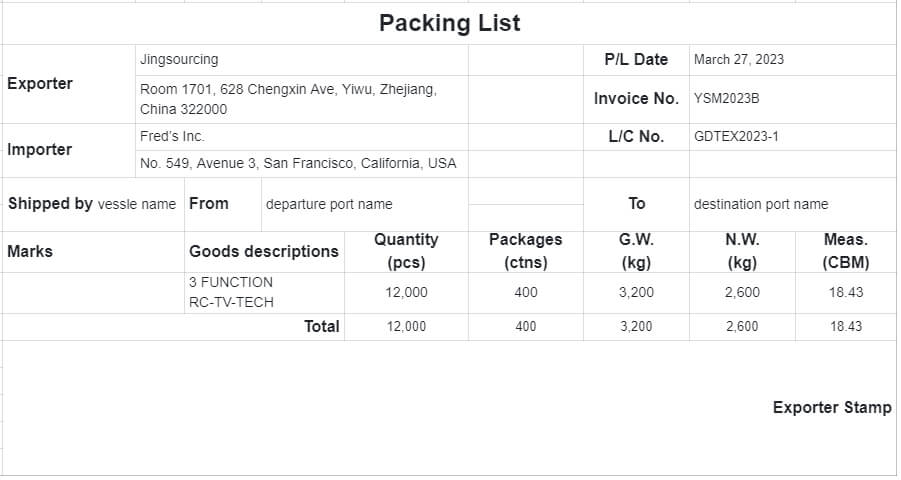
From the example export packing list above, logistics businesses can make several decisions directly related to this document. The information in this document can be used as a reference for creating all export documents, including the commercial invoice, bill of lading, and certificate of origin.
Based on the total weight and volume, freight forwarders can select the most efficient shipping method, whether by air or sea. This information also helps negotiate more competitive rates with logistics service providers.
Furthermore, specifying a clear delivery date helps companies plan and coordinate shipments so that documents can be prepared and submitted to customs on time. You can find the latest customs regulations on their official website.
How to Make a Packing List?
Creating a packing list requires systematic and meticulous preparation. This is because it supports other documents and facilitates the customs clearance process. Here are the steps for creating a packing list.
- Item Identification: Check the order thoroughly and note all items to be shipped.
- Create Document Format: Prepare a packing list document with columns for item name, quantity, weight, dimensions, serial number, and additional information.
- Item Details: Include the name, description, brand, model, or reference number for each item completely and clearly.
- Include Quantity and Physical Specifications: Include the quantity, weight, and dimensions of the item. Provide a serial number for easy tracking and verification.
- Double Check: Make sure all data is correct and matches the order or item list.
- Print and Attach Documents: Once completed, print the packing list and attach it to the package for easy access by the recipient upon arrival.
By following these steps, you’ll have complete and accurate documentation for every shipment. This will help ensure transparency, accuracy, and efficiency in the logistics process.
Conclusion
A packing list is a critical logistical document that includes shipment details such as quantity, type, and product characteristics. This document makes it easier to verify, record inventory, and clear customs during exports and imports, resulting in smooth international transportation and compliance with customs laws.
Making a proper packing list begins with identifying the products, entering their full physical amounts and specifications, and double-checking them before printing and attaching them to the box. To preserve shipping accuracy and efficiency, this practice must be followed consistently.