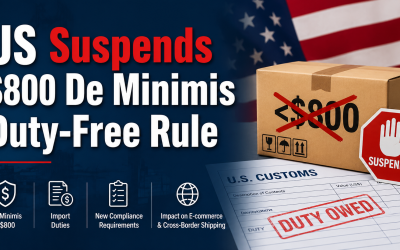
The shipping route between China and the U.S. is very important to global trade because the two countries trade a large volume of goods. By 2025, trade between China and the U.S. is expected to reach $560–570 billion. This corridor is one of the busiest and most important for global shipping because it has so many shipments.
China mostly sells electronics, machinery, furniture, textiles, and industrial tools to the U.S. Most bulk and container cargo is sent by sea, but air freight is used for goods that are very valuable or need to get there quickly. It is important to know the main shipping routes between China and the US, the major ports, the distances, and the usual transit times, regardless of the mode of transportation. This will help things run smoothly and help you reach your business goals.
China – USA Ocean Shipping Routes
Ocean freight remains the backbone of China–US trade, offering cost-effective solutions for moving large volumes of goods across the Pacific. Importers can choose between Full Container Load (FCL) and Less-than-Container Load (LCL) options, depending on the volume and nature of their cargo.
Trans-Pacific: The direct approach
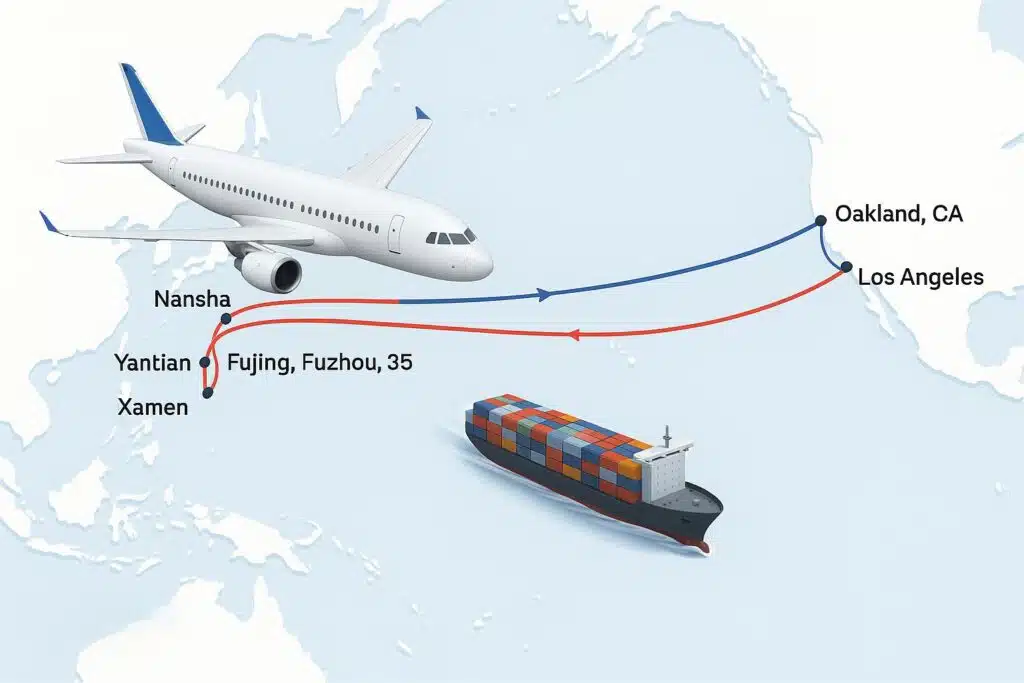
The Trans-Pacific route is the most common way for goods to get from China to the US. This direct, well-known route links major Chinese ports such as Shanghai, Ningbo, and Shenzhen with major US West Coast ports, including Long Beach and Los Angeles. This route is known for its reliability and efficiency. It usually takes 11 to 23 days to get from one port to another, depending on the loading and unloading ports, weather, and operational conditions at the time.
Panama Canal: Crossing the isthmus
The Panama Canal route makes it easier for importers to get to East Coast ports. Ships leave Chinese ports, go through the Panama Canal, and then go straight to East Coast cities like New York or Miami. This reduces the need for inland transport from the West Coast to the East Coast. This choice is great for companies that do business on the East Coast or want to improve their logistics. Note: It usually takes 26 to 47 days for transit.
Suez Canal: A transcontinental journey
This is a longer and less commonly used route—typically chosen when vessels have intermediate port calls or are operating under special circumstances. Ships depart from China, then proceed through the South China Sea, the Indian Ocean, the Red Sea, the Suez Canal, the Mediterranean Sea, and the Atlantic Ocean, before arriving at ports along the U.S. East Coast.
The Suez Canal route can offer meaningful advantages for certain supply chains—especially for goods destined for the U.S. East Coast or even select Midwest markets. That said, transit times for this route tend to be longer, often exceeding 30 days.
Remember, the chosen route may also depend on various factors, such as the shipping company’s schedule and the type of goods. cost, weather conditions, and geopolitical situations.
Air Freight Routes from China to the USA
Air freight significantly reduces transit times. For example, shipping from China to the United States by sea takes 20 to 30 days, but by air it only takes 3 to 7 days. It works best for high-value, time-sensitive cargo, such as electronics, perishable food, and other high-end items. Knowing the most common air freight routes, major hub airports, and average transit times for shipments between China and the US can help shippers carefully weigh the cost of shipping against the need for quick delivery.
Key China to USA Air Freight Routes
Several direct and indirect air freight routes connect major Chinese airports with key U.S. destinations. The most commonly used airports include:
- In China: Beijing Capital (PEK), Shanghai Pudong (PVG), Guangzhou Baiyun (CAN), and Shenzhen Bao’an (SZX)
- In the USA: Los Angeles (LAX), Chicago O’Hare (ORD), New York (JFK), and Dallas/Fort Worth (DFW)
Most international flights follow the north pacific route, passing over northeast China, Alaska, and the northwest of the United States, before descending to inland or coastal destinations.
Transit Time and Flight Distance
Air shipping is ideal when transit time is a priority:
- Typical Flight Duration: Direct flights from Shanghai to Los Angeles or Chicago take around 12–14 hours.
- Flight Distance: The average distance from China to the USA by air ranges between 6,000 to 7,500 miles, depending on origin and destination airports.
- How Long Does Shipping Take: Including customs clearance, total delivery time ranges from 3 to 7 days, making it significantly faster than any sea route.
Key Chinese & U.S. Ports
Understanding the major ports of origin and destination on the China-U.S. shipping routes is crucial for optimizing routes, reducing costs, and improving efficiency. Each port offers unique advantages based on its geographic location, cargo volume, and connectivity to global trade routes.
Major Chinese Ports for Exports to the USA
China’s export network centers on several high-capacity ports along its eastern coast:
- Port of Shanghai: The world’s busiest container port, with direct Pacific access and efficient handling of both bulk and container cargo.
- Port of Ningbo-Zhoushan: A deep-water port with rapid throughput, serving China’s industrial east.
- Port of Shenzhen: Key for Guangdong and South China exports, with strong links to the South China Sea and global shipping lanes.
- Ports of Qingdao, Xiamen, and Tianjin: Supporting hubs offering additional capacity and flexible departures.
These major ports connect to China’s strategic shipping routes—providing both direct and indirect sailings to the U.S.
U.S. West Coast Ports – Primary Entry for Pacific Route
Most sea freight from China enters the U.S. via the West Coast due to its proximity across the Pacific:
- Port of Los Angeles: The largest U.S. port, handling >20% of all U.S. imports. Offers direct access to California’s logistics network and serves as a key Pacific corridor hub.
- Port of Long Beach: Adjacent to LA, it complements LA in processing Asia–U.S. cargo—and often absorbs overflow during LA congestion.
- Port of Oakland and Seattle: Secondary ports gaining traction for faster inland access or to bypass Southern California congestion.
These ports are optimal for the North Pacific route, offering shorter transit times from China.
U.S. East & Gulf Coast Ports
Though less common than West Coast arrivals, many importers ship directly to the East or Gulf Coasts via the Panama or Suez Canals:
- East Coast Ports: New York/New Jersey, Savannah, and Charleston provide access to major East Coast markets—and are gaining popularity amid West Coast port congestion.
- Gulf Coast Ports: Houston and New Orleans handle rising cargo volumes, especially from South China or via the Indian Ocean.
These ports enhance flexibility for inland, South American, Atlantic, or even Western European shipments.
Why Transit Times Vary Between Shipping Routes
Port Congestion and Terminal Efficiency
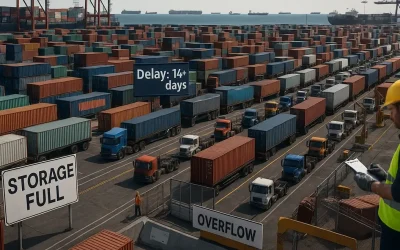
High-volume ports often face congestion, especially during peak seasons. The Ports of Los Angeles and Long Beach—where Long Beach is the largest U.S. West Coast gateway—commonly experience vessel queues and container yard congestion around Black Friday and pre-Christmas periods. Similarly, the Ports of New York/New Jersey and Savannah have experienced periodic congestion in recent months due to import surges. Vessel queues, yard congestion, and crane shortages all delay loading/unloading, extending transit times.
Carrier Schedules, Service Frequency and Network Design
Routes served by multiple carriers (e.g., Maersk, MSC, CMA CGM)—such as U.S. West Coast routes—offer more stable transit times due to higher sailing frequency; e.g., Los Angeles and Long Beach see frequent calls. In contrast, ports like Oakland, Seattle, and Tacoma have fewer sailings, making them more vulnerable to delays from schedule changes or capacity constraints.
Direct Services vs Transshipment-Based Routes
Direct services—e.g., Shanghai/Shenzhen to Los Angeles or Long Beach—offer shorter, more predictable transit times. However, U.S. East Coast shipments (e.g., to New York, New Jersey, Savannah, or Houston) often require transshipment via the Panama Canal or hubs such as Singapore or Busan, adding handling steps and increasing delay risk.
Customs Clearance, Inspections and Regulatory Delays
U.S. Customs and Border Protection (CBP) enforces strict import regulations—especially at major ports like Los Angeles, Long Beach, and New York/New Jersey, where inspection rates are high. Goods subject to FDA or CPSC oversight (e.g., food or electronics) may face longer clearance times. Inaccurate documentation also delays release, as U.S. declaration requirements are stringent.
Inland Transport and Last-Mile Dependencies
Given the U.S.’s vast size, inland transportation significantly affects overall delivery times. For example, shipments from the Port of Los Angeles to inland cities like Chicago, Dallas, and Atlanta typically move by rail (e.g., BNSF, UP) or truck. Rail congestion, driver shortages, or warehouse capacity constraints can still delay deliveries—even if ocean freight is on schedule.
Typical Transit Time Ranges by Route
Transit times are shaped by far more than distance alone. Congestion, carrier behavior, regulatory requirements, and inland logistics all play a critical role. Understanding these factors enables better route selection, more realistic planning, and improved supply chain reliability.
How Long Does Shipping Take from China to the US?
Sea Freight Transit Times (based on direct routes):
- To West Coast ports: 14–18 days
- To East Coast ports: 25–35 days
- To Gulf Coast ports: 28–38 days
These estimates may vary due to port congestion, customs clearance time, and weather conditions. When calculating delivery windows, it’s important to factor in transit time, container loading, and inland transportation.
Air Freight Transit Time and Distance
Air shipping is significantly faster:
- Flight time from major Chinese cities (Shanghai, Beijing, Guangzhou) to U.S. cities (LAX, JFK, ORD): ~12–15 hours
- Total delivery time, including ground handling and customs clearance: 3–7 days
In terms of flight route distance, the typical China to USA flight route spans between 6,000 and 7,500 miles, depending on airports and airspace paths.