
Exporting goods involves more than arranging transportation and preparing cargo for collection. Every international shipment must be supported by accurate documentation that identifies the goods, establishes their value, confirms the shipping arrangements, and satisfies applicable customs and regulatory requirements.
Missing paperwork, inconsistent shipment details, or incorrect product classifications can delay customs clearance, increase shipping costs, and create problems with payment or cargo release. The documents required also depend on the destination country, the type of goods being shipped, the transportation method, and the terms of sale.
This guide explains the essential shipping documents for export, how each document is used, and what exporters should check before their cargo leaves the country.
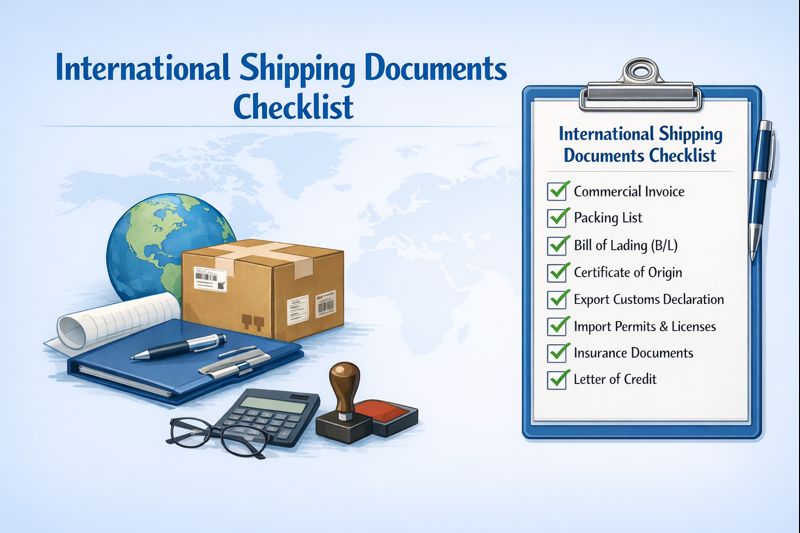
1. What Shipping Documents Do You Need to Export Goods?
The documents required for an export shipment vary according to the cargo, destination, and applicable trade regulations. However, most commercial shipments require a combination of commercial documents, transport documents, and customs paperwork.
1.1 Commercial Invoice
A commercial invoice is one of the most important documents in international trade. It records the transaction between the exporter and the buyer and provides customs authorities with information needed to assess the shipment's declared value and applicable duties and taxes.
A commercial invoice typically includes:
- Exporter and importer names, addresses, and contact details.
- Invoice number and issue date.
- Product descriptions, quantities, and unit prices.
- Total invoice value and currency.
- Country of origin of the goods.
- HS codes, where applicable.
- Applicable Incoterms® rule and named place or port.
- Payment terms and other relevant transaction details.
Customs authorities may use the invoice alongside other documents to determine the customs value of imported goods. Depending on the destination country's valuation rules, the declared value may require adjustments for freight, insurance, assists, royalties, or other relevant costs.
Practical tip: Ensure that product descriptions, quantities, currency, and values are consistent across the commercial invoice, packing list, and customs declaration. Vague descriptions such as "general merchandise" can make it harder for customs officials to identify and classify the goods.
1.2 Packing List
A packing list describes how the goods are packed and provides a breakdown of the shipment's physical contents. It helps freight forwarders, warehouse operators, carriers, and customs officials identify and handle the cargo.
A packing list generally includes:
- Exporter and consignee information.
- Invoice or shipment reference number.
- Product descriptions and quantities.
- Number and type of packages.
- Net weight and gross weight.
- Dimensions of cartons, pallets, or other packages.
- Total shipment volume, usually expressed in cubic meters (CBM).
- Package marks and numbers, if applicable.
Unlike a commercial invoice, a packing list does not primarily establish the transaction value of the goods. Its purpose is to explain what is being shipped and how the cargo is packed.
For example, an exporter shipping 500 cartons of household products should specify the number of cartons, the contents of each package where relevant, and the shipment's total weight and dimensions.
Practical tip: Confirm that the final packing list reflects the cargo actually loaded. Incorrect weights or dimensions can affect freight charges, container planning, cargo handling, and transport documentation.
1.3 Export Customs Declaration
An export customs declaration provides customs authorities with information about goods leaving a country. It is used to report the shipment, support export controls, and establish the information required for customs processing.
Depending on the country, this declaration may be submitted electronically by the exporter, a customs broker, or an authorized representative.
The information generally includes:
- Exporter and consignee details.
- Commodity descriptions and HS classifications.
- Quantity, value, and currency.
- Country of destination.
- Export procedure or transaction type.
- Transport details and other required shipment references.
For example, exporters shipping commercial goods from China may need to complete the applicable export declaration procedures through China's customs system. In the United States, exporters may need to file Electronic Export Information (EEI) through the Automated Export System (AES) when the applicable filing requirements are met.
An export declaration is not the same as an import customs entry. The former reports goods leaving the exporting country, while the latter supports their entry into the destination country.
Practical tip: Determine who is responsible for filing the export declaration before the cargo is collected. The responsibility may depend on the country, the export arrangement, and the parties involved in the transaction.
2. What Are the Three Core Export Documents?
For many standard commercial shipments, three documents form the practical foundation of the export paperwork: the commercial invoice, the packing list, and the transport document. Together, they establish what is being sold, how the cargo is packed, and how it will be transported.
The exact legal requirements differ by country and shipment type, so these three documents should be treated as a common starting point rather than a universal checklist.
2.1 Commercial Invoice: Evidence of the Sale
The commercial invoice records the commercial transaction between the seller and buyer. It provides essential information for customs valuation, trade compliance, and payment processing.
For shipments under a letter of credit, the invoice may also need to meet specific documentary requirements established by the issuing bank. Differences in product descriptions, invoice values, or other required details can create discrepancies during document examination.
2.2 Packing List: A Breakdown of the Cargo
The packing list complements the commercial invoice by identifying the physical composition of the shipment. It is particularly important for consolidated cargo, shipments containing multiple product types, and goods packed into numerous cartons or pallets.
Freight forwarders use the package count, weight, and dimensions to plan handling and transportation. Customs officials may also compare the packing list against the invoice and inspect the cargo if necessary.
2.3 Transport Document: Proof of the Shipping Arrangement
The transport document records key details about the movement of the cargo. Depending on the shipping method, it may take the form of a bill of lading, sea waybill, air waybill, or road consignment note.
It typically identifies the shipper, consignee or notify party, carrier, cargo description, origin, destination, and other relevant transport details.
The legal function of the transport document depends on its type. For example, an original negotiable bill of lading can serve as a document of title, whereas an air waybill is generally non-negotiable and does not function as a document of title.
These three documents should be prepared together and checked for consistency before shipment. Differences in quantities, package counts, weights, or consignee details can result in documentation corrections, customs delays, or difficulties releasing the cargo.
3. What Are the Key Transport Documents for Exporting Goods?
Transport documents establish the arrangements for moving goods from the point of origin to the destination. The appropriate document depends primarily on the transportation mode and the carrier's procedures.
3.1 Bill of Lading (B/L)
A bill of lading is commonly used for international ocean freight. It serves as a receipt for the cargo and evidence of the contract of carriage. Depending on its form, it may also function as a document of title.
A bill of lading usually contains:
- Shipper, consignee, and notify party details.
- Vessel and voyage information.
- Port of loading and port of discharge.
- Description of the goods and package count.
- Gross weight and other cargo particulars.
- Container and seal numbers, where applicable.
- Freight payment terms.
- Issue date and any relevant original-document requirements.
There are several types of bills of lading, including original negotiable bills, straight bills, and sea waybills. Their legal effects and cargo-release procedures are not identical.
For instance, when a shipment moves under an original negotiable bill of lading, the carrier may require the appropriate original document or a valid electronic release arrangement before delivering the cargo. A sea waybill generally permits release to the named consignee without surrendering an original negotiable bill.
Exporters should confirm the required bill of lading format with their freight forwarder before the shipping instructions are finalized.
3.2 Air Waybill (AWB)
An air waybill is the standard transport document for air freight. It provides evidence of the air carriage arrangement and records information about the shipment.
An air waybill generally includes the shipper, consignee, airport of departure, airport of destination, cargo description, gross weight, chargeable weight, and applicable freight charges.
Unlike a negotiable ocean bill of lading, an air waybill is generally non-negotiable and does not transfer ownership of the goods.
Air freight shipments may use a Master Air Waybill (MAWB), issued by the airline or its authorized agent, and a House Air Waybill (HAWB), issued by a freight forwarder for an individual shipment within a consolidated movement.
Practical tip: Check the consignee's name and contact details carefully. Incorrect information can complicate arrival notifications, customs processing, and cargo delivery.
3.3 Road and Rail Consignment Documents
For shipments transported by truck or rail, the required transport document depends on the route, carrier, and applicable legal framework.
Common examples include:
- CMR consignment note: Used for many international road shipments governed by the CMR Convention.
- Rail consignment note: Used to document rail cargo movements under the applicable rail transport arrangements.
- CIM or SMGS consignment documents: Used where the relevant international rail transport regime applies.
These documents record information such as the sender, consignee, carrier, cargo description, package count, and delivery destination. They support the transport process and help establish the responsibilities of the parties involved.
For multimodal shipments, a freight forwarder may issue a multimodal transport document covering movement by two or more modes of transport under the applicable contract.
3.4 Shipping Instructions and Cargo Release Documents
Exporters may also need to prepare shipping instructions for the carrier or freight forwarder. These instructions provide the information required to issue the bill of lading or air waybill, including the shipper's details, consignee information, cargo description, and freight terms.
For ocean freight, additional documents or procedures may be necessary for cargo release, depending on the bill of lading type and the carrier's arrangements. Examples include original bill surrender, a telex release, or an applicable electronic release process.
These are not interchangeable documents. A telex release is generally a carrier release instruction associated with the surrender of an original bill of lading, rather than a separate replacement for every transport document.
Exporters should confirm the release method before the vessel arrives to avoid unnecessary storage charges or delivery delays.
4. Regulatory and Origin Documents
In addition to commercial and transport paperwork, some shipments require documents proving the origin of the goods, demonstrating regulatory compliance, or authorizing the export of controlled products.
4.1 Certificate of Origin (COO)
A Certificate of Origin identifies the country in which the goods originate under the applicable origin rules. It may be required by the importing country, the buyer, a bank, or a trade agreement.
A certificate of origin can help customs authorities determine whether goods qualify for preferential tariff treatment or are subject to origin-related trade measures.
There are two broad categories:
- Non-preferential certificate of origin: Used to establish origin for general trade purposes and other applicable requirements.
- Preferential certificate of origin: Used to support a claim for reduced or zero tariffs under an eligible free trade agreement or preference scheme.
Origin is not always determined solely by the country from which the goods are shipped. Depending on the applicable rules, it may be based on where the goods were wholly obtained, manufactured, or sufficiently transformed.
Not every export shipment requires a certificate of origin. Exporters should confirm the destination country's requirements and the buyer's documentary instructions before arranging one.
4.2 Export Licenses and Permits
Certain products require an export license, permit, or other authorization before they can leave the exporting country. Requirements depend on the product, its technical characteristics, the destination, the end user, and the intended use.
Examples of potentially controlled goods include:
- Dual-use products and certain advanced technologies.
- Military or defense-related equipment.
- Certain chemicals and industrial materials.
- Regulated pharmaceuticals and other controlled products.
- Wildlife products and goods subject to specific environmental restrictions.
An export license is not a standard requirement for every product. However, exporters must determine whether their goods are controlled before shipment and obtain the necessary authorization where applicable.
Using a freight forwarder does not automatically transfer the exporter's legal responsibility for obtaining required licenses or complying with export-control rules.
4.3 Inspection and Conformity Certificates
Some products or markets require pre-shipment inspection, testing, certification, or evidence of conformity with applicable technical standards.
Depending on the product and destination, relevant documents may include:
- Quality inspection certificates.
- Product conformity certificates.
- Certificates of analysis for specified products.
- Phytosanitary certificates for regulated plants and plant products.
- Veterinary or health certificates for applicable animal products and food shipments.
- Fumigation certificates where required.
For example, certain agricultural products may need phytosanitary documentation, while some regulated electrical products may require testing or conformity evidence under the destination country's rules.
These documents are product-specific and should not be assumed necessary for every shipment. Exporters should verify the requirements before production is completed or cargo is dispatched.
4.4 Safety Data Sheets and Dangerous Goods Documents
Shipments containing dangerous goods may require additional safety and transport documentation. The exact requirements depend on the product, its classification, the transport mode, and the applicable regulations.
Relevant documents may include:
- Safety Data Sheet (SDS).
- Dangerous Goods Declaration for applicable shipments.
- Dangerous goods packing certificates or container packing certificates, where required.
- Other mode-specific declarations and supporting documents.
An SDS provides information about a product's hazards, handling, storage, and emergency measures. It does not, by itself, establish that a shipment is properly classified or accepted for transport.
For air freight, applicable International Air Transport Association (IATA) Dangerous Goods Regulations and relevant aviation requirements may apply. Ocean shipments may be subject to the International Maritime Dangerous Goods (IMDG) Code.
Practical tip: Disclose batteries, chemicals, aerosols, flammable materials, and other potentially regulated cargo to the freight forwarder before booking. Incorrect classification or missing dangerous goods paperwork can lead to rejection, rebooking, penalties, or other compliance issues.
5. Specialized Export Documents
Some transactions require additional paperwork because of the nature of the goods, the payment arrangement, the destination, or the buyer's requirements. These documents are not mandatory for every export shipment, but they can be essential in specific circumstances.
5.1 Pro Forma Invoice
A pro forma invoice is a preliminary document issued before the final commercial transaction is completed. It outlines the expected goods, quantities, prices, and proposed terms of sale.
Exporters commonly use pro forma invoices when:
- Providing a quotation to an overseas buyer.
- Supporting an import permit application.
- Helping the buyer arrange a letter of credit.
- Confirming the estimated value and details of a proposed shipment.
A pro forma invoice is generally not a substitute for the final commercial invoice required for a completed commercial shipment.
5.2 Insurance Certificate or Policy
Cargo insurance helps protect against covered loss or damage during transportation. When insurance is arranged for an export shipment, the exporter or other responsible party may need to provide an insurance certificate or policy.
The document may identify the insured party, insured cargo, insured value, route, coverage period, and applicable terms and exclusions.
Whether the seller or buyer arranges insurance depends on the sales contract and agreed Incoterms® rule. For example, under CIF and CIP, the seller has an obligation to arrange insurance in accordance with the relevant rule, although the required level of coverage differs. Under other rules, insurance responsibilities may be allocated differently.
Exporters should review the actual policy wording rather than assuming all transportation risks are covered.
5.3 Letter of Credit Documents
When payment is made under a letter of credit (L/C), the exporter must present the documents specified in the credit within the applicable deadlines.
Depending on the transaction, these may include:
- Commercial invoice.
- Packing list.
- Bill of lading or air waybill, where stipulated.
- Certificate of origin.
- Insurance document.
- Inspection certificate.
- Other documents specifically required by the credit.
Banks examine documents against the terms of the letter of credit and applicable documentary rules. They do not simply determine whether the goods physically match the paperwork.
Even minor discrepancies in names, dates, shipment details, or required wording may lead to a non-complying presentation. Exporters should therefore review the credit requirements before shipment and coordinate the document preparation process with their bank and freight forwarder.
5.4 Beneficiary Certificates and Other Supporting Documents
Some buyers require additional declarations or certificates as part of their purchase agreement or internal compliance procedures.
Examples include:
- Beneficiary certificates confirming compliance with specified contractual requirements.
- Manufacturer's declarations.
- Inspection reports.
- Weight certificates.
- Cargo measurement certificates.
- Statements concerning packaging, labeling, or product specifications.
Whether these documents are necessary depends on the contract, destination, product, and buyer's requirements. Exporters should identify any special documentation obligations when confirming the order, rather than waiting until the cargo is ready for dispatch.
6. Key Considerations for Export Documentation
Preparing the required documents is only part of the export process. The information must also be accurate, consistent, and submitted at the appropriate time. A systematic review can reduce avoidable delays, additional charges, and compliance risks.
6.1 Verify the Importer's and Exporter's Information
Check that the legal names, addresses, and other required identification details of the exporter, importer, consignee, and notify party are correct.
Where the transaction involves a trading company, customs broker, freight forwarder, or third-party warehouse, clarify which entity should appear in each field. The buyer, consignee, importer of record, and notify party may be different entities.
6.2 Keep Cargo Details Consistent Across Documents
Product descriptions, quantities, package counts, gross weights, and other shipment details should match wherever the same information is required.
Pay particular attention to:
- Commercial invoice versus packing list.
- Shipping instructions versus bill of lading or air waybill.
- Customs declaration versus supporting commercial documents.
- Certificate of origin versus the underlying product and manufacturing information.
Some differences may be legitimate because documents serve different purposes, but they should be explainable and supported by the relevant records.
6.3 Confirm HS Codes and Product Descriptions
The Harmonized System (HS) provides an international framework for classifying traded goods. Countries may extend the classification into additional digits for national tariff purposes.
Correct classification is important because it can affect customs duties, trade remedies, import restrictions, licensing requirements, and statistical reporting.
Do not select an HS code based solely on a supplier's suggestion or a similar product found online. Verify the classification against the actual product's materials, function, specifications, and applicable tariff rules.
6.4 Check Country of Origin and Trade Agreement Eligibility
The country of shipment and the country of origin are not necessarily the same. Goods shipped from one country may originate in another, depending on the manufacturing process and applicable origin rules.
If preferential tariff treatment is claimed, confirm that the goods meet the relevant agreement's rules of origin and that the required supporting evidence is available.
Incorrect origin declarations may result in denied preferences, additional duties, penalties, or other customs consequences.
6.5 Understand Incoterms® and Document Responsibilities
Incoterms® rules help allocate certain obligations, costs, and risks between buyers and sellers. They do not replace the sales contract, determine every aspect of ownership, or automatically resolve all customs compliance responsibilities.
Before shipping, confirm who is responsible for:
- Export clearance.
- Import clearance.
- Main transportation costs.
- Cargo insurance, where applicable.
- Delivery to the agreed destination.
- Required shipping and customs documentation.
For example, under EXW, the seller's delivery obligation is generally limited compared with FCA, while FCA often provides a more practical arrangement for export shipments where the seller handles export clearance. The suitability of a rule depends on the transaction and the parties' capabilities.
Always state the applicable Incoterms® rule together with the named place or port and the relevant version, such as Incoterms® 2020.
6.6 Prepare Documents Before the Cargo Is Dispatched
Waiting until the cargo reaches the port or airport to check paperwork can create unnecessary costs. Exporters should establish a document preparation schedule that aligns with cargo readiness, customs filing deadlines, carrier cutoffs, and any licensing or inspection requirements.
A practical workflow is:
- Confirm the buyer's documentation requirements and the agreed sales terms.
- Verify product classifications, origin, and any licensing obligations.
- Prepare the commercial invoice and packing list using confirmed cargo details.
- Arrange required inspections, certificates, and permits.
- Submit the export customs declaration through the appropriate process.
- Provide shipping instructions and verify the transport document draft.
- Confirm the final documents and share the required copies with the buyer and relevant service providers.
- Retain records for the period required by applicable customs, tax, and trade regulations.
The sequence may vary depending on the country, transport mode, and transaction. Some documents must be obtained or filed before loading, while others are issued only after the carrier accepts or receives the cargo.
6.7 Keep Copies and Maintain an Audit Trail
Retain commercial invoices, packing lists, customs declarations, transport documents, certificates, permits, and relevant correspondence.
Electronic records can simplify retrieval, but they should be stored securely and remain accessible for the required retention period. Exporters should also keep supporting evidence for declared values, product classifications, country of origin, and any preferential tariff claims.
Good recordkeeping helps resolve customs inquiries, support financial audits, investigate shipment discrepancies, and respond to disputes with buyers or carriers.
6.8 Work With an Experienced Freight Forwarder
A freight forwarder can coordinate transport bookings, document preparation, cargo handover, and communication with carriers and customs brokers. Depending on the service arrangement, the forwarder may also help identify missing paperwork or inconsistencies before shipment.
However, a freight forwarder does not automatically assume every legal obligation of the exporter or importer. The parties should agree on who prepares each document, who submits customs declarations, and who is responsible for obtaining permits or regulatory approvals.
For exporters managing multiple destinations or shipping methods, a standardized documentation checklist can help prevent repeated errors and make shipments easier to manage.
Conclusion
Export shipping documents provide the information needed to move goods across borders, support customs clearance, and establish the commercial and transportation arrangements. The commercial invoice, packing list, and transport document form the foundation of many shipments, while customs declarations, certificates of origin, licenses, insurance documents, and specialized certificates may be required depending on the transaction.
The most effective approach is to confirm destination-specific requirements early, assign clear responsibility for each document, and verify that all shipment details are consistent before dispatch. With the right documentation process and support from an experienced freight forwarder, exporters can reduce avoidable delays, control logistics costs, and move cargo more reliably through the international supply chain.