
International shipping involves more than simply moving cargo from one country to another. Depending on the shipment, several different companies may be involved in arranging transportation, handling port operations, preparing documents, and coordinating with customs or carriers.
Two terms that often cause confusion are shipping agent and freight forwarder. They are both part of the international shipping process, but they do not perform the same job.
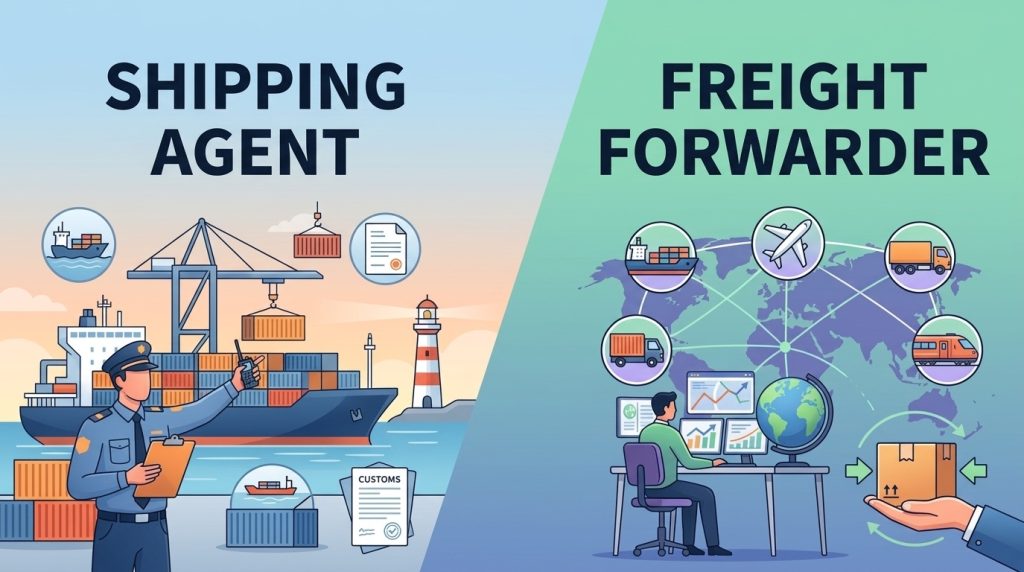
A shipping agent generally works on behalf of the vessel owner or shipping line and focuses on what happens when a vessel arrives at a port. A freight forwarder, on the other hand, works primarily for the shipper and helps arrange the movement of cargo from origin to destination.
Understanding the difference matters because choosing the wrong type of service can create unnecessary delays, extra coordination, or unexpected costs.
This guide explains what shipping agents and freight forwarders actually do, when you may need each one, and how to determine which logistics partner makes sense for your shipment.
The Role of a Shipping Agent
A shipping agent, sometimes referred to as a port agent or vessel agent, represents the interests of a shipowner or shipping line at a particular port.
Their job is mainly connected to the vessel itself and the port call. When a ship arrives, someone needs to coordinate with the port, terminal, pilots, tugboat operators, customs authorities, and other local service providers. That is where a shipping agent comes in.
In simple terms, the shipping agent is the vessel's local representative on the ground.
Key Responsibilities of a Shipping Agent
A shipping agent may be responsible for:
- Arranging vessel arrival and departure clearance
- Coordinating pilotage and tugboat services
- Organizing berthing and docking
- Overseeing cargo loading and unloading
- Managing crew changes, provisions, and fuel bunkering
- Ensuring compliance with local port and customs requirements
- Communicating with port authorities, terminal operators, and shipping lines
These responsibilities are largely focused on making sure the vessel can complete its port call safely and efficiently.
For example, when a container ship arrives at a port, the shipping agent may coordinate the vessel's berthing arrangements, communicate with terminal operators, arrange required services, and handle local formalities before the vessel departs.
The shipping agent is therefore not usually the company an importer contacts to arrange an entire international shipment. Their role is much more closely connected to the vessel and its operations at the port.
When to Use a Shipping Agent
Shipping agents are generally relevant to businesses involved in larger maritime operations, such as:
- Chartering entire vessels or handling breakbulk cargo
- Managing large-scale maritime projects
- Operating or owning vessels
- Coordinating specialized port operations
For the average importer or exporter moving containers or air freight, direct contact with a shipping agent is relatively uncommon.
If you are importing several pallets of products from overseas, for example, you would normally work with a freight forwarder, carrier, or logistics provider rather than contacting the vessel's port agent yourself.
In many cases, the shipping agent is already working behind the scenes on behalf of the ocean carrier.
The Role of a Freight Forwarder
A freight forwarder works from the other side of the transaction.
Instead of representing the vessel owner, a freight forwarder generally represents the shipper—the business or individual that needs to move cargo.
This distinction becomes especially important when a shipment involves several different steps. Your cargo may need to be picked up from a supplier, transported to a port, loaded onto a vessel, cleared through customs, delivered to a warehouse, and then transported to its final destination.
You do not necessarily want to coordinate each of those steps yourself.
That is where a freight forwarder can help.
Responsibilities of a Freight Forwarder
Depending on the service and shipment requirements, a freight forwarder may handle:
- Booking cargo space with ocean, air, rail, or trucking carriers
- Coordinating pickup and final delivery
- Preparing export and import documentation
- Arranging customs clearance and helping with compliance requirements
- Advising on packaging, labeling, and cargo insurance
- Coordinating warehousing, consolidation, and distribution
- Tracking shipments and resolving problems while cargo is in transit
Think of a freight forwarder as an outsourced logistics department.
Instead of having your purchasing team, warehouse team, carrier contacts, customs broker, and transportation providers coordinate separately, a freight forwarder can bring many of these pieces together.
For a business importing goods regularly, that can make a significant difference.
A shipment does not always go exactly according to plan. A vessel can be delayed, a container can be rolled to another sailing, customs may request additional documentation, or cargo may arrive at the destination port before the final delivery is ready.
A freight forwarder can help manage these issues and keep the shipment moving.
When to Use a Freight Forwarder
Freight forwarders are commonly used by businesses that:
- Import or export goods internationally
- Need help with customs and trade requirements
- Want to combine different transportation modes
- Do not have an internal logistics department
- Need assistance with shipping documents and cargo insurance
The size of the shipment is not necessarily the deciding factor.
A company importing a full container of machinery may need a freight forwarder, but so might a small business shipping several pallets of inventory from Asia to the United States.
The more moving parts a shipment has, the more valuable professional coordination can become.
For example, if you are shipping auto parts from China to the United States, the transportation itself is only one part of the process. You may also need to consider classification, documentation, customs clearance, duties, delivery arrangements, and potentially other regulatory requirements.
A freight forwarder can coordinate these logistics steps so you do not have to manage each provider separately.
Which One Do You Need?
The answer depends largely on what you are trying to move and what role you have in the shipping process.
If you are operating a vessel, managing port operations, or coordinating a large maritime project, a shipping agent may be the appropriate partner.
If you are a business that simply needs to move goods from one country to another, a freight forwarder is usually more relevant.
Use a Shipping Agent If:
- You operate or charter a vessel
- You are responsible for vessel operations at a port
- You are managing breakbulk or specialized maritime cargo
- Your shipment requires extensive coordination with port facilities
- You need local support for vessel arrival, berthing, or departure
Use a Freight Forwarder If:
- You are importing or exporting commercial goods
- You need help booking ocean or air freight
- You need transportation arranged from origin to destination
- You need help preparing shipping documentation
- You need customs clearance coordination
- You want one logistics partner to coordinate multiple transportation providers
The confusion usually comes from the fact that both parties can be involved in the same shipment.
A shipping agent may be working with the vessel at the port while a freight forwarder is arranging transportation for the cargo.
They are not competing for exactly the same role.
One is primarily concerned with the vessel and port operation. The other is primarily concerned with the cargo and the shipper's transportation requirements.
Shipping Agent vs. Freight Forwarder
| Shipping Agent | Freight Forwarder | |
|---|---|---|
| Represents | Shipowner or shipping line | Shipper/importer/exporter |
| Main focus | Vessel and port operations | Cargo transportation |
| Port coordination | Yes | Often coordinates through carriers/agents |
| Carrier booking | Usually not the main role | Yes |
| Customs coordination | Port-related requirements | Import/export customs coordination |
| Pickup and delivery | Generally not the primary responsibility | Yes |
| Warehousing | Not usually | Often available |
| Shipment tracking | Vessel-focused | Cargo-focused |
| Best suited for | Vessel owners, operators, charterers, large maritime projects | Importers, exporters, manufacturers, distributors, and businesses moving cargo internationally |
How a Freight Forwarder and Shipping Agent Work Together
It is also important to understand that using a freight forwarder does not mean a shipping agent disappears from the process.
In fact, the two may work together.
Consider a typical full-container shipment.
You purchase goods from an overseas supplier and need to deliver them to your warehouse. Your freight forwarder may arrange the inland pickup, book space with an ocean carrier, prepare the necessary documentation, coordinate export procedures, and arrange destination delivery.
Once the vessel reaches the destination port, the shipping agent may handle the vessel's local requirements, including port communication, berthing, and other operational matters.
The forwarder continues to coordinate the movement of your cargo.
This is one reason importers generally do not need to contact the shipping agent directly. The forwarder or ocean carrier may already be coordinating with the agent as part of the overall shipment.
From the importer's perspective, the important question is usually not “Who is the shipping agent?” but rather “Who is responsible for making sure my cargo gets from the supplier to the final destination?”
How to Choose the Right Logistics Partner
Choosing a logistics partner should start with the actual requirements of your shipment.
If your business imports goods regularly, look beyond the freight rate alone. A low initial quote does not necessarily mean a lower final shipping cost if the service excludes important transportation or handling charges.
Before choosing a logistics provider, consider:
Transportation Coverage
Does the provider handle the mode you need?
Depending on your shipment, this could include:
- Ocean FCL
- Ocean LCL
- Air freight
- Rail freight
- Trucking
- Multimodal transportation
If your cargo requires several modes, having one provider coordinate the different legs can make the process easier.
Customs and Documentation Support
International shipments involve paperwork at multiple stages.
Ask whether the logistics provider can help with export documentation, import documentation, customs clearance, and other compliance requirements relevant to your cargo.
A documentation problem can delay a shipment just as easily as a transportation problem.
Port and Carrier Network
Experience at the origin and destination ports can also matter.
A provider familiar with local terminals, carriers, customs procedures, and trucking capacity may be better positioned to respond when something changes.
This becomes especially useful when ports are congested or when vessel schedules change.
Shipment Visibility
You should also know how your cargo is tracked.
A reliable logistics provider should be able to give you meaningful shipment updates rather than simply telling you that the cargo is “in transit.”
For businesses managing inventory, knowing when cargo is picked up, loaded, discharged, cleared, and scheduled for final delivery can make planning much easier.
Problem-Solving Support
International shipping rarely goes perfectly every time.
A container may miss a sailing. A vessel may arrive late. Customs may request additional information. A delivery appointment may need to be rescheduled.
Ask how the provider handles these situations before you choose them.
The difference between a logistics partner that simply books freight and one that actively manages the shipment often becomes obvious when something goes wrong.
Simplifying International Shipping
Shipping agents and freight forwarders both play important roles in international logistics, but they solve different problems.
A shipping agent works primarily on behalf of the vessel or shipping line, coordinating port operations and helping the vessel complete its port call.
A freight forwarder works primarily for the shipper, arranging transportation, documentation, customs coordination, and delivery from origin to destination.
For most businesses importing or exporting commercial goods, the freight forwarder is the more relevant point of contact.
That does not mean the shipping agent is unimportant. In the background, shipping agents help keep vessels, terminals, and port operations moving. The freight forwarder coordinates these moving parts from the cargo owner's perspective.
If you are unsure which type of logistics service you need, start by looking at the shipment itself.
Ask yourself:
Do I need someone to manage the vessel at the port, or do I need someone to manage my cargo from origin to destination?
For most importers and exporters, the second question points toward a freight forwarder.
Once that distinction is clear, it becomes much easier to understand who should handle your shipment, what services you actually need, and where each party fits into the international supply chain.