
When you’re shipping goods from China to the UK, the first question is usually simple: How long will it take to get my goods?
The answer depends on how you ship them.
Sea freight is generally the most economical option for larger shipments, but it takes longer. Air freight is much faster, although the cost is higher. Express courier services can move smaller shipments even faster, while rail freight can sit somewhere between ocean and air in terms of transit time and cost.
For most shipments, you also need to look beyond the actual time a vessel or aircraft spends in transit. Factory pickup, export customs clearance, port handling, cargo consolidation, UK customs clearance, and final delivery can all add days to the schedule.
Quick Answer: You can generally expect 25–35 days for ocean freight, 5–10 days for standard air freight, 3–6 days for express courier delivery, and around 18–22 days for rail freight from China to the UK. These are planning ranges rather than guaranteed delivery times.
This guide breaks down the typical transit times for each shipping method, what can cause delays, and how to build a more realistic delivery schedule.
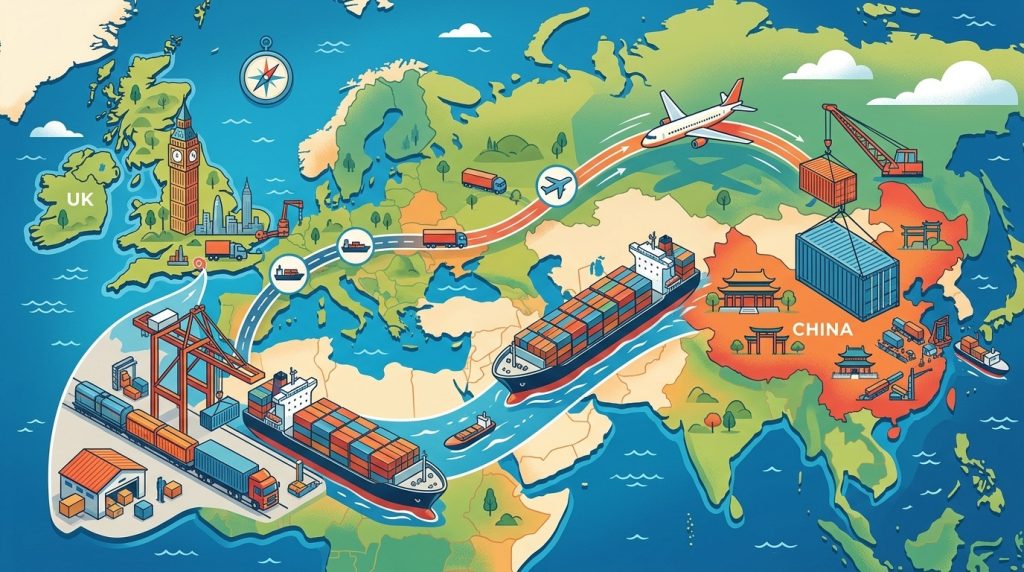
Ocean Freight Transit Times: China to the UK
For most commercial importers, ocean freight remains the practical choice when the shipment is too large, heavy, or expensive to move by air.
Major Chinese departure ports include Shanghai, Ningbo, Shenzhen, and Qingdao. In the UK, common destinations include Felixstowe, Southampton, and London Gateway.
Current ocean routes can take longer than they did in previous years because many services are routing around the Cape of Good Hope instead of using the Suez Canal. The exact transit time also depends on the carrier, vessel schedule, port pair, and whether the shipment is FCL or LCL.
| Origin Port | Destination Port | Port-to-Port Transit |
|---|---|---|
| Shanghai | Felixstowe | 28–33 days |
| Ningbo | Southampton | 27–32 days |
| Shenzhen (Yantian) | London Gateway | 25–30 days |
| Qingdao | Felixstowe | 32–36 days |
These figures reflect current FCL routing conditions. A shipment can take longer if the vessel is delayed, the sailing is rolled, or the container misses its scheduled departure.
LCL Shipping Adds More Time
If you do not have enough cargo to fill a container, LCL (Less than Container Load) can be a useful alternative to FCL.
But there is a trade-off.
Your cargo must be delivered to a consolidation warehouse in China, wait for the CFS cutoff, and be loaded with other shipments. Once it reaches the UK, the cargo must also be unloaded and separated before it can be released for final delivery.
As a result, LCL can add around 5–8 days compared with the underlying port-to-port FCL transit time.
For example, an LCL shipment from Shanghai to Felixstowe that would take about 30 days as FCL may take roughly 35–38 days through the consolidation process.
Door-to-Door Shipping Takes Longer Than Port-to-Port
A common mistake is to use the vessel’s transit time as the expected delivery date.
If a shipping line quotes 30 days from port to port, that does not mean your goods will arrive at your warehouse in 30 days.
You still need to account for:
- Factory pickup
- Export customs clearance
- Origin port handling
- Ocean transit
- UK port handling
- Import customs clearance
- Final-mile transportation
For example, a door-to-door FCL shipment from a factory in Ningbo to a warehouse in the UK Midlands may take around 35–42 days under normal conditions.
What matters: When planning inventory, use the total door-to-door delivery time, not just the vessel’s port-to-port transit.
Air Freight Transit Times: China to the UK
If your shipment is time-sensitive, air freight is usually the faster option.
Major Chinese air cargo gateways include Shanghai Pudong (PVG), Guangzhou Baiyun (CAN), and Shenzhen Bao’an (SZX), with London Heathrow (LHR) and Manchester (MAN) serving as major UK destinations.
The actual flight may only take around 11–13 hours. But your shipment is not delivered the moment the aircraft lands.
Your goods still need to be collected, cleared for export in China, processed at the airport, cleared through UK customs, and delivered to the final destination.
| Air Freight Route | Approximate Flight Time | Door-to-Door Transit |
|---|---|---|
| Shanghai (PVG) → London (LHR) | 11–12 hours | 5–10 days |
| Guangzhou (CAN) → London (LHR) | 12–13 hours | 5–10 days |
| Shenzhen (SZX) → London (LHR) | 12–13 hours | 5–10 days |
For standard air freight, planning around 5–10 days door-to-door is more realistic than planning around the flight duration alone.
Express Shipping: When Time Matters More Than Cost
For smaller and urgent shipments, express services such as DHL, UPS, and FedEx can provide door-to-door delivery in approximately 3–6 days.
Express is faster because the courier generally controls more of the transportation process through a single network. You also avoid some of the consolidation and deconsolidation steps involved in standard air freight.
The trade-off is straightforward: you pay more for the shorter transit time.
For urgent samples, documents, replacement parts, or smaller commercial shipments, that additional cost may be worthwhile. For larger inventory shipments, standard air or ocean freight is often more economical.
Rail Freight: An Intermediate Option
Rail freight between China and Europe can provide another option when ocean freight is too slow but air freight is too expensive.
Shipments moving through the Eurasian rail corridor from cities such as Chengdu, Xi’an, and Zhengzhou can reach European rail terminals in roughly 18–22 days door-to-door, depending on the service and destination.
That puts rail somewhere between ocean and air in terms of transit time.
However, rail availability, routing, border procedures, and service schedules can change. It is therefore best viewed as an alternative for specific cargo and delivery requirements rather than a universal replacement for sea or air freight.
What Can Delay a Shipment from China to the UK?
The transit times above assume relatively normal operating conditions.
In real-world shipping, things do not always go according to the original schedule.
A shipment can be delayed by a missed cutoff, port congestion, customs clearance, vessel changes, weather, or simply a lack of available capacity.
Cape of Good Hope Routing
One of the biggest factors affecting current China-to-UK ocean transit times is vessel routing.
When services route around the Cape of Good Hope instead of passing through the Suez Canal, the voyage can add approximately 10–14 days compared with the traditional route.
This is one reason older China-to-UK transit estimates may no longer reflect the current schedule.
Peak Season
Peak season can create another set of problems.
Cargo volumes typically increase before major shopping periods, Golden Week, and Chinese New Year. When demand rises, containers can become harder to secure, ports can become congested, and bookings may be rolled to a later sailing.
If your inventory is tied to a product launch or a fixed customer delivery date, leaving no buffer during peak season can create problems very quickly.
UK Port Congestion
Even when a vessel arrives on schedule, the container may not immediately leave the port.
High yard density, discharge delays, equipment availability, and driver appointment shortages can all affect the time between vessel arrival and final delivery.
A vessel arriving on schedule does not necessarily mean your cargo is ready for delivery.
UK Customs Clearance
Customs can also affect the final delivery timeline.
Import declarations, VAT and duty checks, documentation reviews, and physical inspections may add several days when an entry requires additional attention.
Current planning guidance suggests allowing around 3–7 days for UK customs-related delays when a shipment is selected for additional checks.
Most shipments do not experience every possible delay. The point is to understand where additional time can be introduced so you are not surprised when the original ETA changes.
Weather and Other Disruptions
Weather can affect both ends of the route.
Typhoons in or around the South China Sea can disrupt departures from Chinese ports, while severe weather in Northern Europe can affect vessel arrivals and port operations.
These disruptions are difficult to predict far in advance, which is another reason not to plan a shipment around the shortest possible transit time.
How to Plan Around China-to-UK Transit Times
If you have a fixed delivery date, do not simply choose a shipping method based on the advertised transit time.
Instead, work backward from when you actually need the goods.
Recommended Planning Windows
| Shipping Method | Typical Transit | Practical Planning Window |
|---|---|---|
| Ocean FCL | 25–35 days | Around 40 days |
| Ocean LCL | 30–40+ days | Around 45–50 days |
| Standard Air | 5–10 days | Around 8–10 days |
| Express | 3–6 days | Around 5 days |
| Rail | 18–22 days | Allow additional buffer |
For ocean FCL shipments, a 40-day planning window provides a more realistic buffer than using the vessel’s shortest port-to-port estimate.
For LCL, consider allowing 45–50 days.
For standard air freight, planning around 8–10 days is reasonable, while express shipments can often be planned around approximately 5 days under normal conditions.
Don’t Miss the Cargo Cutoff
Your transit clock effectively starts before the vessel or aircraft leaves China.
FCL shipments may have a gate-in cutoff several days before vessel departure. LCL shipments usually have an earlier CFS cutoff because the cargo must be delivered to the consolidation warehouse before loading.
If you miss the cutoff, your cargo may simply wait for the next sailing.
A missed cutoff can turn a small scheduling mistake into an additional 7-day delay on a weekly service.
Build in Extra Time During Peak Season
If you are shipping shortly before Chinese New Year or during a major retail peak, add another 7–10 days to your planning window.
This does not mean your shipment will definitely be delayed by that amount. It simply gives you some room if capacity tightens or schedules change.
Plan for the Full Journey
The safest way to estimate your delivery date is to include every stage:
Factory pickup → Export clearance → Origin handling → International transit → UK customs → Port handling → Final delivery
This is especially important if you are managing inventory for customers.
A 30-day ocean transit may sound straightforward, but if you need the goods available in your warehouse by a specific date, the relevant number is the total door-to-door timeline.
Frequently Asked Questions
How long does sea freight take from China to the UK?
Sea freight generally takes around 25–35 days port-to-port on current routes, although some port pairs can take longer. For door-to-door delivery, allow additional time for pickup, customs clearance, port handling, and final delivery.
How long does air freight take from China to the UK?
Standard air freight generally takes around 5–10 days door-to-door. The actual flight may only take around 11–13 hours, but customs clearance, handling, pickup, and final delivery account for most of the additional time.
What is the fastest way to ship from China to the UK?
Express courier is generally the fastest option for smaller shipments, with typical door-to-door delivery of around 3–6 days. Air freight is another fast option for larger or more time-sensitive commercial cargo.
Is LCL slower than FCL from China to the UK?
Usually, yes. LCL requires consolidation in China and deconsolidation in the UK, which can add approximately 5–8 days compared with the underlying FCL port-to-port transit.
Why is my China-to-UK shipment taking longer than the quoted transit time?
A quoted transit time is normally an estimate under expected operating conditions. Delays can come from vessel routing, missed cutoffs, port congestion, customs checks, peak-season demand, weather, or changes to the carrier schedule.
If your shipment is delayed, first find out where the delay actually occurred. A vessel delay, customs hold, and final-mile delivery issue require very different solutions.
The Bottom Line
There is no single transit time that applies to every shipment from China to the UK.
For planning purposes:
- Ocean freight: around 25–35 days port-to-port
- LCL: generally longer because of consolidation and deconsolidation
- Standard air freight: around 5–10 days door-to-door
- Express: around 3–6 days
- Rail: around 18–22 days door-to-door
The important thing is not to plan around the fastest number you see.
If you are shipping inventory for a customer order, product launch, or seasonal sales period, give yourself enough time for the parts of the journey that are easy to overlook—factory pickup, customs clearance, consolidation, port handling, and final delivery.
A realistic delivery window may require a little more planning upfront, but it is far better than discovering that your “30-day shipment” still has another week to go before the goods reach your warehouse.