
If you’re shipping commercial goods from China, air freight can be one of the fastest ways to get inventory where it needs to go. But the rate you see quoted per kilogram is rarely the full cost.
Air freight pricing depends on several moving parts, including chargeable weight, destination, airline capacity, fuel surcharges, seasonality, cargo type, and destination handling. A shipment that looks inexpensive at the quotation stage can end up costing considerably more once customs, handling, and delivery charges are added.
This guide explains how air freight rates from China are calculated, what importers can expect to pay in 2026, what affects the final price, and how to request a quote without leaving important costs out of the equation.
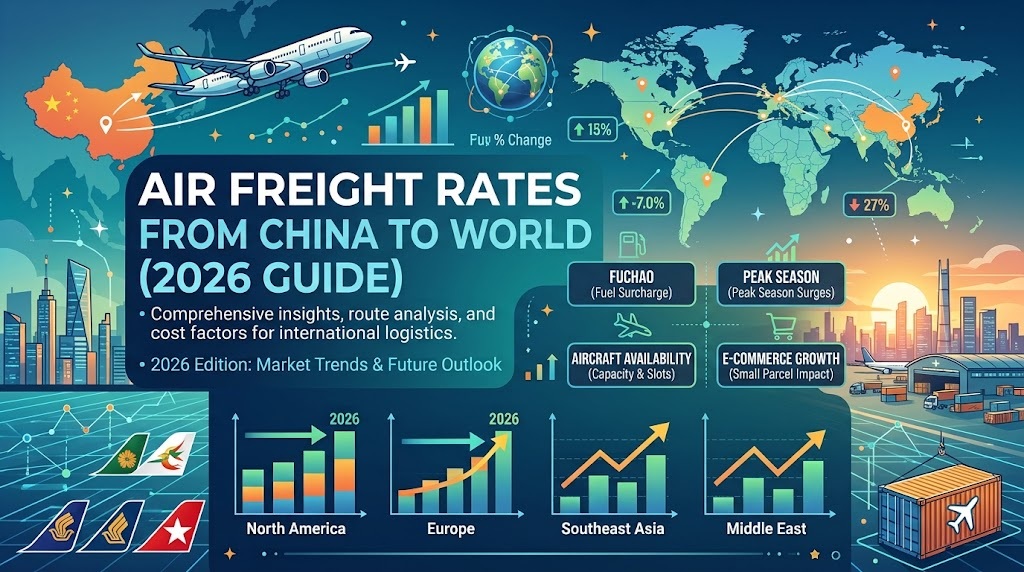
What Are Air Freight Rates from China?
Air freight rates are the transportation charges used to move cargo from a Chinese airport to a destination airport.
That sounds straightforward, but there’s an important detail: airlines generally do not charge simply based on the physical weight of your shipment.
Instead, the rate is applied to the shipment’s chargeable weight, which is whichever is greater between the actual gross weight and the volumetric weight.
Standard airport-to-airport air freight typically includes the basic transportation charge, fuel-related charges, and security fees. It may not include customs duties, destination taxes, terminal handling, customs brokerage, pickup, or final delivery.
Rates also change regularly.
Airline capacity, jet fuel prices, seasonal demand, available freighter space, and changes in international trade routes can all affect what you pay from one week to the next.
For importers, this means a rate from last month is not necessarily a reliable benchmark for your next shipment.
Why Air Freight Rates Matter to Importers
Air freight is often treated as the expensive alternative to ocean shipping. That is true in terms of the rate per kilogram, but the decision is not always that simple.
For businesses carrying time-sensitive inventory, faster transportation can reduce stockouts, shorten product launch timelines, and reduce the amount of inventory sitting in transit.
Depending on the trade lane, air freight from China can take around 1–3 days for regional routes and roughly 3–7 days for longer international routes before additional customs and final-delivery time is considered.
For importers, the main advantages include:
- Speed: Get inventory into the destination market much faster than ocean freight.
- Predictability: Air schedules can make planning easier for time-sensitive shipments.
- Lower inventory exposure: Faster transportation means less inventory tied up in transit.
- Cargo security: Fewer handling points and shorter transit times can reduce the risk of damage or loss.
- Flexible capacity: Importers can choose between direct flights, connecting services, and additional capacity during busy periods.
The trade-off is cost.
If you are importing large volumes of low-value goods, air freight may not make economic sense. But for high-value, lightweight, urgent, or time-sensitive cargo, the additional freight cost may be justified by the time saved.
Chargeable Weight: The Foundation of Air Freight Pricing
One of the most common surprises for new air freight importers is chargeable weight.
You may have a shipment that weighs 100 kg on a scale and assume the airline will charge you for 100 kg. That is not necessarily how air cargo pricing works.
Airlines compare:
- Actual Weight: The physical weight of the shipment, including packaging and pallets.
- Volumetric Weight: A calculation based on how much space the shipment occupies.
The higher of the two becomes the chargeable weight.
How Is Volumetric Weight Calculated?
For standard air freight, the commonly used IATA calculation is:
Volumetric Weight = Length × Width × Height (cm) ÷ 6000
For express courier services such as DHL, FedEx, or UPS, a divisor of 5000 is commonly used instead.
Example: Why Packaging Matters
Imagine you have 100 kg of products packed into large cartons measuring 120 cm × 80 cm × 100 cm.
The volume calculation would be:
120 × 80 × 100 = 960,000 cm³
960,000 ÷ 6000 = 160 kg
Your actual weight is 100 kg, but the volumetric weight is 160 kg.
That means the shipment would normally be charged based on 160 kg, not 100 kg.
This is why packaging matters more than many importers expect.
Reducing empty space, choosing appropriately sized cartons, and improving packaging density can lower the chargeable weight and, in turn, the freight cost.
Current Air Freight Rates from China to World Regions
Air freight rates are normally quoted using weight brackets such as +45 kg, +100 kg, +300 kg, +500 kg, and +1000 kg.
As shipment weight increases, the per-kilogram rate often becomes more competitive.
The following figures provide 2026 benchmark ranges for standard general cargo weighing more than 100 kg. These are indicative airport-to-airport rates rather than guaranteed quotations.
| Destination Region | Transit Time | Standard Rate (+100 kg) | Peak / High-Volume Rate | Main Destination Hubs |
|---|---|---|---|---|
| North America | 3–5 days | $5.00–$7.77/kg | $7.00–$9.50/kg | LAX, ORD, JFK, DFW, YVR, YYZ |
| Europe | 1–4 days | $4.00–$6.60/kg | $6.00–$7.50/kg | FRA, LHR, CDG, AMS, BRU, MXP |
| Middle East / Gulf | 1–3 days | $4.80–$6.30/kg | $6.00–$7.50/kg | DXB, AUH, RUH, JED, DOH |
| Southeast / East Asia | 1–3 days | $1.76–$4.10/kg | $3.50–$5.20/kg | SIN, BKK, SGN, MNL, KUL, CGK |
| Australia / Oceania | 1–3 days | $3.67–$5.00/kg | $5.00–$6.50/kg | SYD, MEL, AKL |
| South America | 5–7 days | $8.50–$9.24/kg | $9.50–$11.00/kg | GRU, EZE, SCL |
| Africa | 5–7 days | $8.06–$8.80/kg | $9.00–$10.50/kg | JNB, LOS, CAI, NBO |
These figures are best used as a starting point when budgeting for a shipment. They exclude local customs duties, taxes, origin pickup, destination handling, and final delivery.
If you need a firm rate, you will need to provide the actual shipment details to a freight forwarder.
What Determines Air Freight Rates?
There is no single number that determines what you will pay for air freight.
Several factors can change the rate significantly.
1. Trade Lane Demand and Airline Capacity
Some routes have large amounts of available cargo capacity because they are served by frequent passenger flights and dedicated freighters.
Others have fewer direct services and require one or more connections.
When capacity is limited, rates tend to rise.
This is one reason China-to-North America and China-to-Europe rates can behave differently from less frequently served destinations.
2. Seasonal Demand
Air freight is particularly sensitive to peak periods.
Two periods deserve special attention:
Q4 E-Commerce Peak
From October through December, holiday shopping increases demand for air cargo capacity. During periods of tight capacity, rates can rise significantly, with peak-market increases of around 20%–50% possible.
Pre-Chinese New Year Rush
Before factories close for Chinese New Year, many businesses try to move inventory before production and transportation slow down.
That can create a short-term rush for available air cargo space and push spot rates higher.
If your shipment is time-sensitive, booking at the last minute during these periods can be expensive.
3. Fuel and Security Surcharges
The base freight rate is not always the entire airline charge.
Air carriers may also apply fuel and security surcharges, which can change as operating costs change.
This is why two quotations with similar base rates can still produce different final totals.
4. Cargo Type and Special Handling
Standard general cargo usually receives the simplest pricing.
Special cargo is different.
For example:
- Dangerous goods: Lithium batteries, chemicals, liquids, and other regulated cargo may require special packaging, labeling, declarations, and carrier approval.
- Temperature-controlled cargo: Pharmaceuticals and certain perishables require specialized handling and cold-chain infrastructure.
- Oversized or heavy cargo: Cargo that exceeds standard pallet dimensions or aircraft loading limits may require specialized freighter capacity.
If you do not disclose the cargo type when requesting a quote, the initial price may not reflect the actual cost of moving the shipment.
The Costs Behind the Air Freight Rate
The number you see as a price per kilogram is only one part of the logistics bill.
A more realistic way to look at the cost is:
Total Air Freight Cost = Base Freight + Origin Charges + Fuel/Security Surcharges + Destination Charges + Customs + Final Delivery
Depending on the shipment, additional charges may include:
- Origin Terminal Handling: Charges for cargo processing, loading, and handling at the Chinese departure airport.
- Destination Terminal Handling: Charges for unloading, sorting, and handling at the destination airport.
- Customs Brokerage: Fees for preparing and submitting customs documentation.
- Export Screening or Inspection: Charges associated with security screening or physical inspection.
- Airport Storage: Additional storage fees if cargo remains at the airport beyond the free storage period.
- Customs Duties and Taxes: Government charges based on the destination country's regulations.
- Final Delivery: Trucking or local delivery from the destination airport to the consignee.
This is why comparing freight rates on a simple “dollars per kilogram” basis can be misleading.
The cheapest base rate is not always the cheapest shipment.
How to Get an Accurate Air Freight Quote
If you want a useful quotation, give your freight forwarder enough information to price the shipment correctly the first time.
At a minimum, provide:
1. Origin and Destination
Provide the Chinese departure city or airport and the destination airport or final delivery address.
For example:
Shenzhen (SZX) → Chicago (ORD)
is more useful than simply saying:
China → USA
2. Weight and Dimensions
Provide the total gross weight and the dimensions of every package.
Include:
- Number of cartons
- Length
- Width
- Height
- Gross weight
This allows the forwarder to calculate the chargeable weight accurately.
3. Commodity Information
Describe the goods clearly.
If applicable, provide:
- Product name
- HS Code
- Material information
- Product photos
- MSDS for chemicals or batteries
- Dangerous goods information
A vague description such as “parts” or “electronics” may not be enough to determine the correct handling requirements.
4. Incoterms and Service Requirements
Tell the forwarder whether the shipment is EXW, FOB, DAP, DDP, or another Incoterm.
Also specify whether you need:
- Airport-to-airport service
- Door-to-door service
- Express delivery
- Standard air freight
- Customs clearance
- Final-mile delivery
The more complete the information, the less likely you are to receive a quote that changes later.
How Can You Reduce Air Freight Costs?
You do not always need to find a cheaper airline to lower your air freight bill.
In many cases, the biggest savings come from how the shipment is prepared.
Optimize Your Packaging
Large, lightweight packages can create a high volumetric weight.
Use appropriately sized cartons and remove unnecessary empty space wherever possible.
For products such as textiles, packaging optimization can make a noticeable difference.
Consolidate Shipments
If you are sending several smaller shipments, ask whether they can be consolidated.
Higher weight brackets such as +100 kg, +300 kg, and +500 kg often offer lower rates per kilogram.
Instead of paying several small-shipment rates, combining cargo may give you access to a more competitive bracket.
Consider Sea-Air Transportation
Not every shipment needs to move entirely by air.
For cargo that is urgent but still cost-sensitive, a sea-air solution can sometimes provide a middle ground between traditional ocean freight and full air freight.
Cargo may move by sea to a regional hub such as Dubai or Singapore and then continue by air.
Book Ahead During Peak Seasons
If you already know your shipment will move during Q4 or the period before Chinese New Year, do not wait until the last minute.
Booking several weeks ahead can give you better access to capacity and reduce your exposure to peak spot rates.
Final Thoughts
Air freight from China remains an important option for businesses that need speed, reliable inventory movement, and access to international markets.
But getting a good air freight rate is about more than finding the lowest price per kilogram.
You need to understand how chargeable weight works, what the quoted rate actually includes, how seasonal demand affects capacity, and which destination charges will be added later.
For importers, a better approach is to look at the total landed cost rather than the headline freight rate.
Before requesting a quote, have your shipment dimensions, weight, commodity details, destination, and Incoterms ready. That gives your forwarder the information needed to provide a more accurate price and reduces the chance of unexpected charges later.
If you regularly ship from China, reviewing your packaging, consolidating shipments, and planning around peak seasons can also make a meaningful difference to your overall transportation cost.
Frequently Asked Questions
How much does air freight from China cost per kg?
There is no single worldwide rate, For standard shipments over 100 kg, 2026 benchmark rates can range from around $2.50 to $9.50 per kg depending on the destination, shipment weight, cargo type, and market conditions.
Asian routes are generally less expensive, while long-haul routes to Africa, South America, North America, and Europe can cost more.
Is air freight cheaper than DHL, FedEx, or UPS?
It depends on the shipment.
For smaller shipments, particularly those below roughly 45–100 kg, express carriers can sometimes be competitive because their rates often include door-to-door transportation and customs handling.
For larger commercial shipments above 100 kg, traditional air freight usually offers a lower cost per kilogram.
The best option depends on the total landed cost, not simply the quoted freight rate.
How long does air freight from China take?
Airport-to-airport flight time can be as short as 1–3 days on some routes.
Once export handling, customs clearance, destination processing, and final delivery are included, door-to-door transit is typically around 3–7 business days.
Actual timing depends on the destination, flight schedule, carrier, customs processing, and delivery arrangement.
What is the difference between EXW, FOB, and DDP air freight?
The main difference is who is responsible for the costs and logistics steps.
EXW: The buyer is responsible for the shipment from the supplier's facility, including pickup, export clearance, international freight, and destination delivery.
FOB: The supplier handles the agreed origin responsibilities up to the point specified under FOB, while the buyer takes responsibility for the international transportation and destination costs.
DDP: The seller or logistics provider manages the shipment through to the final destination, including applicable import clearance, duties, taxes, and delivery.
If you are comparing quotes from different forwarders, make sure you are comparing the same Incoterm and service scope. Otherwise, a lower quote may simply be leaving more costs for you to pay later.