
A commercial invoice is an important document issued by the exporter to the importer, serving as proof for the seller to request payment from the buyer for the goods sold. It also has the following additional functions:
- A commercial invoice is used in both the country of origin and the destination country to ensure compliance with commercial rules and the correct payment of taxes and customs duties.
- In the event of loss or damage to goods during shipment, the commercial invoice provides the necessary information to support insurance claims.
- The buyer should submit the commercial invoice to their bank upon receiving the goods to expedite payment.
- According to US export regulations, exporters must retain commercial invoices for five years from the date of shipment.
- Exporters can use this invoice to support claims under overseas credit risk insurance.
To meet these requirements, ensure that your export commercial invoice includes all the details listed below, as well as those in the quotation, order form, and order confirmation documents.
A commercial invoice differs from a pro forma invoice, which is used as a prepayment invoice. Pro forma invoices are an important tool that enables buyers to obtain a letter of credit or an import license prior to the international shipment of goods.
Commercial Invoice Checklist for Exports
The content of a commercial invoice mostly similar to a tax invoice. Here’s a breakdown of details needs to be included:
- Company name, address and contact details of the exporter
- Company name, address and contact details of the importer
- Buyer’s details in case they are not a consignee
- Type of shipment
- Mode of dispatch
- Name of the vessel and voyage number
- Date and invoice number
- Names of the loading and discharge port
- Destination of the goods
- Name of the country where goods originated
- Bill of lading number
- Marine cover policy and Letter of Credit
- Terms of payment
In addition, every commercial invoice contains details of the products. For example, the invoice specifies the product description, quantity, HSN/HS code, unit type, currency, and price. Furthermore, the terms of trade and other important terms of the agreement between the trading parties must also be specified on the invoice. Finally, the name, date, and signature of the authorized representative of the relevant company must also be specified on the commercial invoice.
A unique identifier and the date of issuanceDescription of GoodsClear, detailed explanation of each itemHS CodeEnter the correct code (Harmonized System code) for tariff classification of each productQuantity & UnitsNumber of pieces, boxes, or itemsValueUnit price and total price (in currency used)Country of OriginWhere the goods were manufacturedIncotermsTerms of sale (e.g., FOB, CIF, DDP)Shipping InfoMode of transport, carrier name, tracking numberInsuranceInclude insurance details and coverage if applicableSignatureOften required from the exporter to confirm the info
Who is responsible for preparing commercial invoices?
In cross-border trade, exporters or sellers are generally responsible for issuing the commercial invoice and double-checking all information related to the goods. In B2C sales or when working with external logistics partners, your shipping company or customs agent can assist you in issuing the invoice.
Please always ensure that all information is correct. Errors, especially in values or HS codes, can cause delays at customs and even result in costly penalties.

How to Create a Commercial Invoice for International Shipping
To create a commercial invoice that complies with commercial and customs standards, follow these steps:
1. Enter the sender and recipient details
Start by entering all the necessary information about the sender and recipient:
- Sender’s name and address (including VAT number, if applicable).
- Recipient’s name and address, including intra-community VAT number or any other required tax identification number.
- Contact details for both parties (phone number, email address).
2. Please write the invoice number and the date it was issued.
Every invoice must have its own unique number so that we can keep track of it. This number must be sequential and include the date of issue. This date is important for deciding how you will pay and which taxes you need to pay.
3. Detailed Product Information
Product descriptions must be comprehensive and accurate. Provide detailed specifications for each item:
- Product name.
- Detailed description (product type, materials, components).
- Quantity sold.
- Unit of measurement (e.g., kilograms, units).
- If applicable, include gross and net weight.
- Interna
- tional tariff code (HS code) for customs identification.
- Country of origin.
4. Indicate the value of the goods.
Tell me the unit price and the total amount for each item, based on the number of items. Also specify the currency you used for the transaction (e.g., Euro, US Dollar). Make sure the total invoice amount is clearly displayed, including all the goods items.
5. Specify Payment Terms
Clearly define the mutually agreed payment terms, such as:
- Payment terms (e.g., net 30 days).
- Accepted payment methods (bank transfer, credit card, etc.).
- Any applicable discounts or rebates.
6. Determining delivery terms (Incoterms)
If you are trading with other countries, you must clearly specify the applicable international trade terms (Incoterms). This text specifies the obligations of the buyer and seller regarding shipping, insurance, and delivery risks.
Examples of different shipping types include EXW, FOB, and CIF.
7. Add Legal Disclaimer
In most countries, commercial invoices must include certain information:
- VAT numbers of both parties.
- Terms of sale and delivery time.
- Carrier information (if applicable).
- If necessary, mention cargo insurance.
8. Calculate and List Applicable Taxes
If taxes are due on the sale, clearly indicate them on the invoice. This may include:
- Value Added Tax (VAT).
- Any applicable customs duties.
- Other taxes or fees that may be levied by the destination country/region.
9. Verify Consistency and Retain a Copy
Before sending the invoice, ensure all information is accurate and consistent with other shipping documents (e.g., packing list or waybill).
Always retain a copy of the commercial invoice for your records.
10. Send the Invoice and Track the Transaction
Once the invoice is ready, send it to the customer using the agreed-upon method (email, postal mail, or online platform). Be sure to follow up on the transaction and confirm the customer has received the invoice to avoid any misunderstandings.
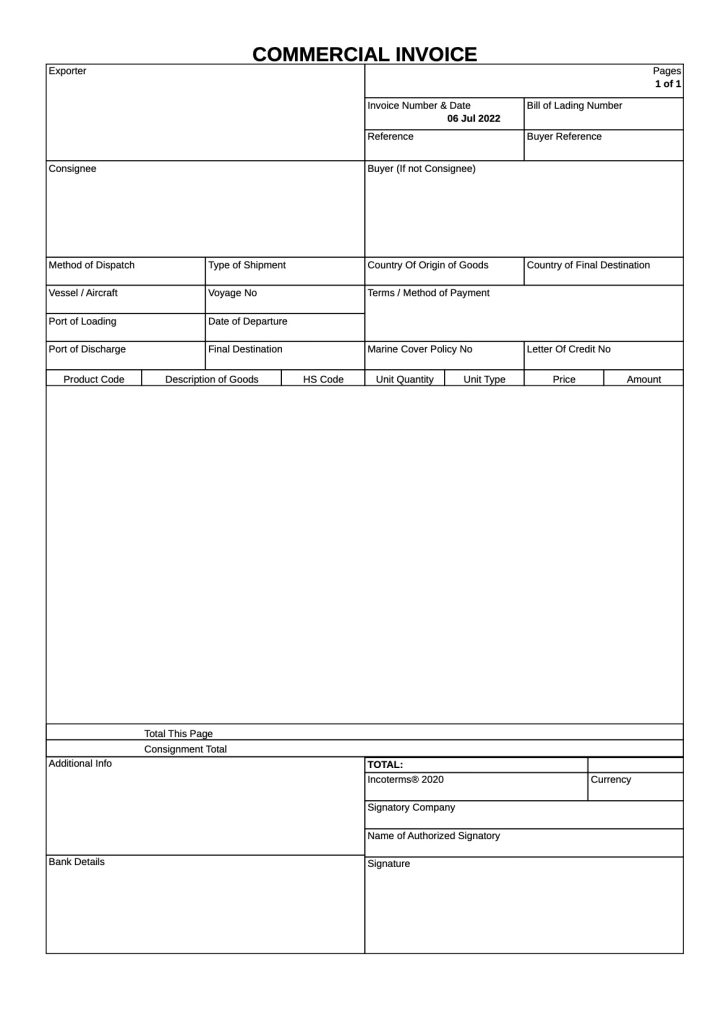
Commercial Invoice Sample
Conclusion
Export commercial invoices are financial and legal records that support the efficiency of global commercial transactions rather than mere physical documents. By using the appropriate export invoice format and including all necessary information, exporters can prevent delays and focus on growing their business.
Whether you are a small exporter or a large company, meticulous document organization is the first step toward successful, seamless exporting. With Ssfeshipping, your goods transportation process will be as efficient and easy as that of other companies.