
Those who work in foreign trade have to deal with complex contracts and a series of logistical, tax, and operational obligations. To make this process simpler and more standardized, there are Incoterms — international rules that guide buyers and sellers on costs, risks, and duties in the transportation of goods.
Among the terms most commonly used in multimodal trade, Incoterm FCA stands out for its flexibility and clarity in allocating responsibilities.
In this article, you will understand what Incoterm FCA means, how risk transfer works, who pays each expense, and how it differs from popular terms such as FOB and EXW.
What are Incoterms?
Incoterms — short for International Commercial Terms — are international standards published by the International Chamber of Commerce (ICC). They objectively define who is responsible for each stage of transport of goods, from packaging and customs clearance to payment of freight and insurance.
By including an Incoterm in a contract, the parties standardize the negotiation and reduce the risk of conflicts, delays, and unexpected costs.
What does the FCA term mean in Incoterms?
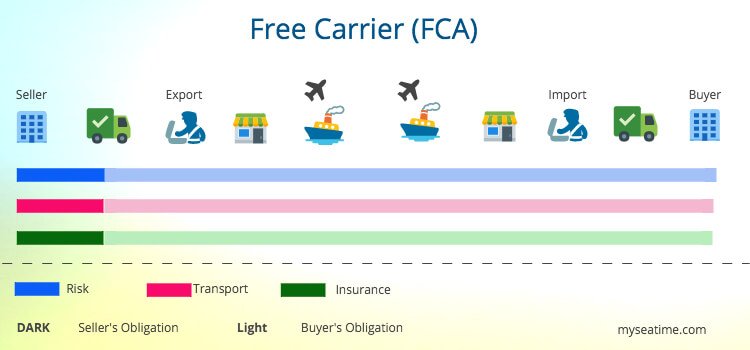
“Free Carrier” means that the exporter is responsible for delivering the products to the carrier the importer has chosen at the location the importer has chosen. At this point, the risk and responsibility are transferred, and the importer is responsible for the costs and risks of transporting the products internationally.
In an FCA (Free Carrier) contract, it’s vitally important to explicitly specify the delivery location. This is because it decides who is in charge of loading and moving the goods. One of the best things about FCA is that it is flexible. It can be used for any type of foreign transit, whether air, rail, road, or ocean freight.
Because of this flexibility, FCA is ideal for many transactions involving multiple modes of transportation, such as when products are initially delivered by truck to a port and then loaded onto a ship. Another advantage of FCA is that the importer can choose the delivery site, giving them more control over the logistics.
Essential Elements of FCA Delivery Terms
- Place of Delivery: In FCA delivery, the place of delivery can be a point agreed upon between the seller and the buyer. This point can usually be the seller’s factory, warehouse, or another location.
- Carrier Selection: The buyer selects the carrier and makes the transportation arrangements. The seller delivers the goods to the carrier designated by the buyer.
- Customs Procedures: The seller completes the export customs procedures. The buyer is responsible for the import customs procedures.
- Transfer of Risk and Costs: The risk and costs pass to the buyer when the goods are delivered to the carrier.
Who pays freight and insurance under FCA terms?
The cost allocation mechanism for FCA is as follows:
Seller: Pays only domestic transportation costs to the agreed delivery location and handles customs clearance (or export clearance).
Buyer: Bears all subsequent costs, including:
- International freight
- International insurance
- Post-arrival expenses at destination
- Import customs clearance
This clear division helps minimize disputes and provides financial predictability for both parties.
Seller’s Responsibilities Under FCA Incoterms
The seller’s obligations under FCA delivery are as follows:
- Preparation of the goods covered by the contract and the necessary documents (documents may be prepared physically or digitally),
- Completing customs procedures, taxes, and expenses related to export,
- Preparing, inspecting, measuring, weighing, and marking the goods covered by the contract and paying the related expenses,
- Requesting a bill of lading from the carrier,
- Preparing other export documents such as invoices and packing lists,
- Providing the buyer with the information and documents necessary for the buyer to enter into a contract of carriage with a carrier,
- Assuming the risks and damages until the goods are delivered to the main carrier,
- If the buyer is going to enter into an insurance contract, providing the buyer with the information and documents necessary for this contract,
- Notifying the buyer when the goods are ready for delivery from the ship.
Buyer’s Responsibilities Under FCA Incoterms
The buyer’s obligations under the FCA delivery term are as follows:
- Payment of the price of the goods to the seller as specified in the contract,
- Acceptance of the goods upon their arrival at the place specified in the contract,
- Assuming all liability for damage and risk after the seller delivers the goods,
- Arranging a contract of carriage with a carrier for the transportation of the goods and paying the related expenses,
- Obtaining the delivery note issued by the seller after delivery of the goods,
- Providing the seller with any information and documents necessary for the seller to complete customs procedures related to export,
- Performing the necessary procedures related to import and paying the expenses,
- Covering the expenses for the procedures after the goods are left with the buyer,
- Notifying the seller in advance of the place and time of delivery so that the seller can deliver the goods.
| Responsibility | Seller | Buyer |
|---|---|---|
| Delivery Point | Up to the agreed location | From the agreed location |
| Packaging and Inspection | Yes | No |
| Export Customs Clearance | Yes | No |
| Inland Transport at Origin | Yes | No |
| International Freight | No | Yes |
| International Insurance | No | Yes (optional) |
| Import Customs Clearance | No | Yes |
Where is FCA Transportation Used?
The Free Carrier delivery method has a wide range of applications thanks to its flexibility and versatility in international trade.
- All Modes of Transport: FCA can be used for all modes of transport, such as road, sea, air, and rail. This flexibility makes it easy to adapt to different logistics needs.
- Export and Import Transactions: It is ideal when the seller must complete export customs procedures and deliver the goods to the buyer-specified carrier.
- Working with Logistics Companies: The FCA delivery method is also suitable when the buyer contracts with a logistics company to manage transportation. This method allows the buyer to manage all stages of the shipment.
- Multimodal Transport: FCA is also preferred in multimodal transport, where multiple modes of transport are used. This ensures that responsibilities are clearly defined in complex logistics operations.
How is FCA Delivery Arranged?
FCA delivery is a flexible method that can be used in all modes of transport. Step-by-step implementation of FCA:
- Contract preparation: A sales contract is prepared between the seller and the buyer. This contract clearly specifies where and in what condition the goods will be delivered.
- Carrier arrangements: The buyer selects the carrier for the goods and agrees on the delivery date/time.
- Export procedures: The seller prepares the customs declaration and completes the export customs procedures.
- Preparation of goods: The seller packages the goods and prepares the necessary documents, like the invoice, packing list and certificate of origin.
- Delivery: The seller delivers the goods and documents to the carrier at the designated point.
- Insurance and freight: The buyer arranges transportation insurance and pays the freight charges.
How is the Price Calculated for FCA Delivery?
The seller bears the costs incurred until the goods are delivered to the carrier designated by the buyer. Therefore, when calculating the FCA price, costs under the seller’s responsibility are included.
- Product Cost: The cost of producing or sourcing the product.
- Profit Margin: The seller’s target profit margin.
- Packaging and Loading Costs: The costs of packaging and loading necessary for the safe transport of the product.
- Internal Transportation Costs: The internal transportation costs of the goods from the seller’s premises to the carrier designated by the buyer.
- Export Customs Clearance Costs: Customs procedures and related taxes required for export.
What is the Difference Between FOB and FCA?
FOB (Free On Board) and FCA (Free Carrier) are Incoterms rules frequently used in international trade. The main differences between the two delivery terms are:
| Criteria | FOB (Free On Board) | FCA (Free Carrier) |
|---|---|---|
| Place of Delivery | Goods are loaded onto the vessel designated by the buyer. | Goods are delivered to the carrier or delivery point designated by the buyer. |
| Transfer of Risk | Risk transfers to the buyer once the goods are loaded on board the vessel. | Risk transfers to the buyer once the goods are delivered to the carrier. |
| Mode of Transport | Applicable only to sea and inland waterway transport. | Applicable to all modes of transport, including road, sea, air, and rail. |
| Export Customs Clearance | Handled by the seller. | Handled by the seller. |
| Insurance | Not mandatory; the buyer may arrange insurance. | Not mandatory; the buyer may arrange insurance. |
| Cost Allocation | Costs up to loading on the vessel are borne by the seller. | Costs up to delivery to the carrier are borne by the seller. |
| Scope of Use | Specific to maritime transport only. | Suitable for all types of transport. |
What is the Difference Between FCA and EXW?
FCA (Free Carrier) and EXW (Ex Works) delivery terms define the responsibilities and risks of the parties in international trade.
| Criteria | FCA (Free Carrier) | EXW (Ex Works) |
|---|---|---|
| Place of Delivery | The seller delivers the goods to the carrier or another person nominated by the buyer at the agreed place. This place may be the seller’s premises or another agreed location. | The seller places the goods at the disposal of the buyer at the seller’s premises (factory, warehouse, workplace, etc.). The seller is not required to load the goods onto the transport vehicle. |
| Customs Procedures | The seller is responsible for completing export customs clearance. Import customs procedures are the buyer’s responsibility. | Both export and import customs procedures are carried out by the buyer. The seller does not handle customs clearance. |
| Loading Responsibility | If delivery takes place at the seller’s premises, the seller is responsible for loading the goods onto the transport vehicle. If another delivery place is agreed, loading responsibility lies with the buyer. | The seller is not required to load the goods onto the transport vehicle. This responsibility lies with the buyer. |
| Risk and Costs | Risk and costs transfer to the buyer once the goods are delivered to the carrier. Transport and insurance costs are borne by the buyer. | Risk and costs transfer to the buyer once the goods are placed at the buyer’s disposal at the seller’s premises. All transport, insurance, and customs costs are borne by the buyer. |
FAQ's
What does FCA delivery term mean?
FCA delivery term stands for Free Carrier. In this delivery term, the seller delivers the goods to the carrier at the designated point.
Who is responsible for insurance in FCA delivery?
The buyer is responsible for insurance. The buyer must arrange transportation insurance against risks.
Who pays the freight in FCA?
The freight is the responsibility of the buyer. All transportation costs after delivery of the goods are borne by the buyer.
Who pays customs expenses in FCA delivery?
Export customs expenses are paid by the seller, and import customs expenses are paid by the buyer.